
Groups that shape community culture face financial pressure
Clip: 7/31/2026 | 7m 15sVideo has Closed Captions
Local arts groups that shape community culture face financial pressure
Larger theater companies, venues and museums typically get more attention. But in cities and rural areas, it’s smaller arts organizations that are closest to and address the needs of their communities. Now, many are struggling as they face economic pressures. Jeffrey Brown reports for our Art in Action series, which explores the intersection of art and democracy as part of our CANVAS coverage.
Problems playing video? | Closed Captioning Feedback
Problems playing video? | Closed Captioning Feedback
Major corporate funding for the PBS News Hour is provided by BDO, BNSF, Consumer Cellular, American Cruise Lines, and Raymond James. Funding for the PBS NewsHour Weekend is provided by...
Groups that shape community culture face financial pressure
Clip: 7/31/2026 | 7m 15sVideo has Closed Captions
Larger theater companies, venues and museums typically get more attention. But in cities and rural areas, it’s smaller arts organizations that are closest to and address the needs of their communities. Now, many are struggling as they face economic pressures. Jeffrey Brown reports for our Art in Action series, which explores the intersection of art and democracy as part of our CANVAS coverage.
Problems playing video? | Closed Captioning Feedback
Where to Watch PBS News Hour
PBS News Hour is available to stream on pbs.org and the PBS app.
Providing Support for PBS.org
Learn Moreabout PBS online sponsorshipAMNA NAWAZ: Larger theater companies, music venues, and museums typically get more attention, but across the country, it is smaller arts organizations that are often closest to and addressing the needs of their local communities.
Facing tougher economic pressures today, though, many are struggling to do that.
Senior arts correspondent Jeffrey Brown traveled to the Twin Cities for our series Art in Action, exploring the intersection of art and democracy, part of our Canvas coverage.
JEFFREY BROWN: It's visually exciting, orally electrifying, a full-body explosion of movement and powerful sound.
Here at TaikoArts Midwest in St.
Paul, Minnesota, where this small but mighty collective was rehearsing for an upcoming performance of the ancient Japanese art form, drumming is a way of life.
JENNIFER WEIR, Executive Director, TaikoArts Midwest: They're incredible because they're so large that, when we play them, you feel it.
You feel your ribs rattle a little bit.
JEFFREY BROWN: Jennifer Weir is the executive director of the organization and has been studying, performing, teaching, and composing taiko for over 25 years.
What does it do for you?
JENNIFER WEIR: We get this immediate response and immediate connection with people, and we find that it's healing, it's empowering, and it's something that brings people together.
JEFFREY BROWN: For many, coming together has never felt so urgent, so necessary here in the Twin Cities.
Waves of trauma from the murder of George Floyd to the COVID-19 pandemic to the recent ICE surge that left Renee Good and Alex Pretti dead have rocked the region over the last six years.
Small community groups like TaikoArts Midwest have been on the front lines, getting out of the studio and into the streets, even in the freezing cold.
JENNIFER WEIR: We show up with our drums, and then it just amplifies the feeling.
It's like getting plugged in to a collective energy source.
I have never experienced anything like it.
And that's after, like, being on stage and having lights and costumes and all those things.
Like, there's nothing... JEFFREY BROWN: All the normal performance-type -- yes.
Yes.
JENNIFER WEIR: Yes.
Yes.
But when you're in community, really truly in the thick of it, it's profound.
JEFFREY BROWN: Another local arts group, Mixed Blood Theatre, in neighboring Minneapolis, has also been in the thick of it.
A group of writers was recently commissioned to chronicle events during the ICE surge in a series of monologues.
ACTOR: Yes.
No, no, state-sanctioned violence.
JEFFREY BROWN: The performance also raised money for the Immigrant Law Center of Minnesota.
MARK VALDEZ, Artistic Director, Mixed Blood Theatre: It's doing what's right.
JEFFREY BROWN: Through theater.
MARK VALDEZ: Through theater.
A lot of the work that we have been doing is around rapid response.
JEFFREY BROWN: Mark Valdez is the artistic director of Mixed Blood, which has been around for 50 years.
MARK VALDEZ: We are foremost a social justice organization, secondarily a theater company.
JEFFREY BROWN: That's -- so that's how you think of it.
MARK VALDEZ: That's how I... (CROSSTALK) MARK VALDEZ: Correct.
We use the tools of theater.
We use the tools of creativity of art making to disrupt injustice, to build community, to advance racial equity.
JEFFREY BROWN: At its core is an idea known as radical hospitality, which Mixed Blood applies through free admission to shows, transportation assistance for people with disabilities, collecting stories while building relationships with neighbors, and more, all, says Valdez, as an artistic response to crisis.
MARK VALDEZ: So one of the most successful things that we did was we offered say your rights out loud trainings.
So we invited people to come in.
We hired actors to play the parts of ICE agents, and participants came in and would just practice saying their rights out loud just to prepare themselves for... JEFFREY BROWN: So a kind of rehearsal or a kind of performance, but with real consequences.
MARK VALDEZ: With real consequences, yes.
We are now at a point where we have to decide, what kind of a community do you want to live in?
JEFFREY BROWN: But that kind of decision also comes at a moment of existential financial crisis for many arts groups here and around the country.
According to national data from 2024, arts nonprofits' revenues have not kept pace with inflation, while individual foundation, corporate, and public support declined.
And that's before recent cuts and pushback from the Trump administration.
LAURA ZABEL, Founding Director, Creative Change Coalition: That combination of lack of resources and enormous responsibility and pressure of the -- all of these kind of compounding crises that we're living through, I think is a really tough moment for local cultural organizations.
JEFFREY BROWN: Are we losing some of them here in the Twin Cities?
LAURA ZABEL: Absolutely.
LAURA ZABEL: Here in the Twin Cities, around the country.
JEFFREY BROWN: Laura Zabel served as longtime executive director of Springboard for the Arts, a St.
Paul-based organization that provides resources for artists.
She's now taking the work national as founding director of the new Creative Change Coalition to build a larger network of local cultural organizations around the country.
LAURA ZABEL: We have these foundational, bedrock, usually very small local cultural organizations in almost every community in America.
And they are in this moment being asked to respond to the kind of highest needs of their community, whether that's economic security or the opioid crisis or climate, social connection and the loneliness epidemic.
And they're doing all of that with the lint from their pocket.
JEFFREY BROWN: Zabel believes arts groups should double down on their community ties, proving their value.
LAURA ZABEL: Those organizations, I think, are some of the last organizations that have the trust of their communities.
JENNIFER WEIR: Yes, if you think of this as a lever, and your pinkie grip is going to snap right at the end.
Yes.
And then now stretch up.
Stretch up.
JEFFREY BROWN: Back at TaikoArts Midwest, I got my own lesson in sound movement and power, banging the hira-daiko drum.
JENNIFER WEIR: It doesn't have to be pretty.
There's no wrong or right way to do this.
JEFFREY BROWN: Exhilarating, exhausting., the kinds of emotions Jennifer Weir says she experiences daily, both in her art and keeping her organization alive.
JENNIFER WEIR: Operating at a deficit, and we're just trying every day to fill that gap.
JEFFREY BROWN: So, it's a survival issue?
JENNIFER WEIR: It is.
And I don't think everyone will survive.
And I think, much like your small businesses or your immigrant businesses, people have to show up to show what they value, or it won't be there in the next year.
And that's especially true in the arts.
But on the flip side of that, and all that sort of existential and financial terror is this feeling that what we're doing has never had more importance or more of an impact.
Like, it's more important now than ever.
JEFFREY BROWN: For now, the beat and the work go on.
For the "PBS News Hour," I'm Jeffrey Brown in St.
Paul, Minnesota.
Brooks and Capehart on Blanche’s stalled AG confirmation
Video has Closed Captions
Brooks and Capehart on Blanche’s stalled nomination and Trump's 'anti-weaponization fund' (10m 42s)
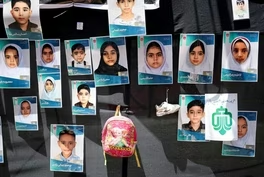
How people in Iran feel after living through months of war
Video has Closed Captions
How Iranians are living through months of war and government crackdowns (6m 10s)

Migrants enter Spanish territory, then return to Morocco
Video has Closed Captions
Tens of thousands of migrants enter Spanish territory, then return to Morocco (3m 7s)
Unaccompanied migrant children could lose legal aid
Video has Closed Captions
Unaccompanied migrant children at risk of losing legal representation (5m 49s)
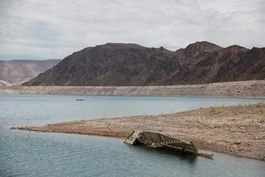
Western states face water cuts as Colorado River shrinks
Video has Closed Captions
Western states face more water cutbacks as Colorado River shrinks (4m 53s)
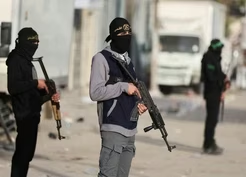
What's in the deal to disarm Hamas, withdraw IDF from Gaza
Video has Closed Captions
What's in the proposed deal to disarm Hamas and withdraw Israeli forces from Gaza (5m 46s)

Why states want to change 'Sell By' labels on food
Video has Closed Captions
Why states want to change 'Sell By' labels on food (3m 20s)
Providing Support for PBS.org
Learn Moreabout PBS online sponsorship
- News and Public Affairs

FRONTLINE is investigative journalism that questions, explains and changes our world.
 New Episode
- News and Public Affairs

Today's top journalists discuss Washington's current political events and public affairs.

 New Episode
 New Episode
 New Episode
 New Episode
 New Episode
 New Episode

 New Episode
 New Episode
Support for PBS provided by:
Major corporate funding for the PBS News Hour is provided by BDO, BNSF, Consumer Cellular, American Cruise Lines, and Raymond James. Funding for the PBS NewsHour Weekend is provided by...