
Strange Fruit
2/10/2026 | 52m 24sVideo has Closed Captions
Episode Two of BLACK AND JEWISH AMERICA reveals Black & Jewish work in art & culture.
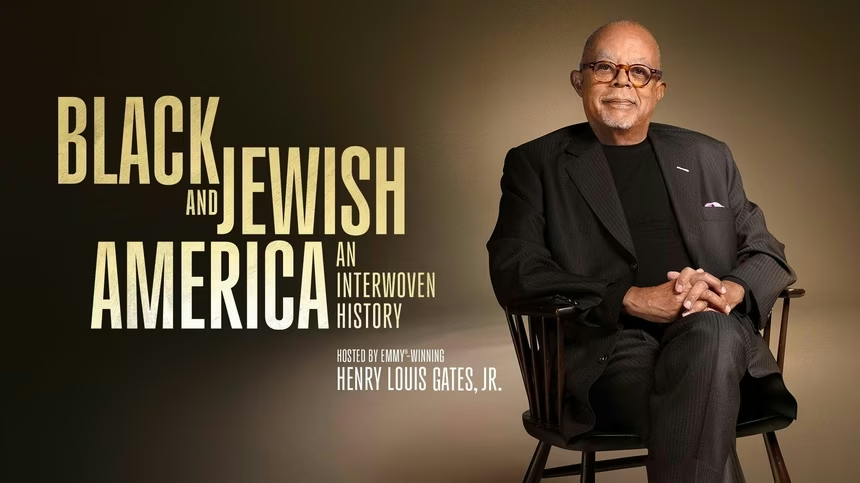
Episode Two of BLACK AND JEWISH AMERICA: AN INTERWOVEN HISTORY explores the alliances between Black and Jewish communities in the first half of the 20th century, and their divides. From the Harlem Renaissance and Great American Songbook to fighting Nazis, it examines influential collaborations, frictions, and the lasting cultural and social impact of their intertwined histories.
From
Problems playing video? | Closed Captioning Feedback
Problems playing video? | Closed Captioning Feedback
Corporate support for BLACK AND JEWISH AMERICA: AN INTERWOVEN HISTORY was provided by Bank of America and Johnson & Johnson. Major support was provided by the Corporation for Public Broadcasting....
Strange Fruit
2/10/2026 | 52m 24sVideo has Closed Captions
Episode Two of BLACK AND JEWISH AMERICA: AN INTERWOVEN HISTORY explores the alliances between Black and Jewish communities in the first half of the 20th century, and their divides. From the Harlem Renaissance and Great American Songbook to fighting Nazis, it examines influential collaborations, frictions, and the lasting cultural and social impact of their intertwined histories.
From
Problems playing video? | Closed Captioning Feedback
How to Watch Black and Jewish America: An Interwoven History
Black and Jewish America: An Interwoven History is available to stream on pbs.org and the free PBS App, available on iPhone, Apple TV, Android TV, Android smartphones, Amazon Fire TV, Amazon Fire Tablet, Roku, Samsung Smart TV, and Vizio.
Community Engagement & Discussion Guide
This guide will point you to resources, partners and suggestions that allow you to create the engagement opportunities that truly connect, invigorate and inspire your communities.Providing Support for PBS.org
Learn Moreabout PBS online sponsorship-Even as outsiders in their own country, Black and Jewish people reshaped almost every corner of American popular culture in the first half of the 20th century.
-A white Jewish producer and the greatest Black jazz singer of all time working together to produce art.
-They worked together in clubs and studios... -Black culture could always make you hip by association.
-...on stage and screen and on the playing field.
-Marker.
-The Jews made the movies and made Israel in California, and it's called Hollywood.
♪♪ -By the 1930s, the rise of fascism in Europe drew Black and Jewish Americans even closer, as Nazi propaganda borrowed pages from the Jim Crow playbook.
-Nazis think, hey, somebody has already done the homework.
We don't have to invent it.
-Here were two Jewish-American athletes kept from the winning podium so as not to further embarrass Adolf Hitler.
-The Holocaust devolved over time.
-After the Holocaust, there was a heightened awareness of their shared suffering as well as a growing recognition of their differences.
-I said to myself, My God, who are these people?
What have they done that was so terrible?
-American Jewish history has been a history of rapid social mobility.
African-American history has been a history of enslavement and institutional racism.
At what point in the alliance are those historical differences going to be seen?
♪♪ ♪♪ ♪♪ -♪ Southern trees ♪ ♪ Bear a strange fruit ♪ ♪ Blood on the leaves ♪ ♪ And blood at the root ♪ ♪ Black bodies swinging ♪ ♪ In the Southern breeze ♪ ♪ Strange fruit hanging ♪ ♪ From the poplar trees ♪ ♪♪ -Billie Holiday's classic ballad "Strange Fruit" is a timeless protest against racial hatred and mob violence, but it's also a deeply moving collaboration between Blacks and Jews.
Written by Abel Meeropol, a Jewish schoolteacher from New York City, "Strange Fruit" originated as a poem expressing outrage at lynchings throughout the South.
The poem was arranged as a song, and when pitched to Billie Holiday at the height of her career, she not only embraced it, she would make it a classic.
-And in '39, people did not want to know about lynching.
And that was her passion to get this song recorded.
-Actor and comedian Billy Crystal has a surprising personal tie to "Strange Fruit" through his family.
-My grandfather, Julius, he had this electronic store also where he sold all kinds of stuff -- lightbulbs, sneezing powder, and rubber hot dogs and, you know, Chinese finger... -Oh, yeah, I remember those.
-Those things.
-Yeah.
-And then his oldest son, Milt, started working there, and Uncle Milt then turned that little hardware store into the center of jazz called the Commodore Music Shop.
Then he said, "Why are we gonna sell other people's records?
Why don't we make our own?"
-Right.
-And that was the beginning of the Commodore Jazz label, Classics in Swing, which became, in America, the first independent jazz label of its time.
-Billy's uncle, Milt Gabler, first heard "Strange Fruit" sung by Holiday herself, who performed it in the family store, hoping that Milt would record it.
-According to him, she sang it in the store a cappella.
-Hmm.
-And he said to me, "I just -- I cried like a baby.
I said, 'We gotta record this thing.'
I don't care if we make a buck."
-Because he was so deeply moved, Billy's Uncle Milt took the courageous step of recording "Strange Fruit" on his Commodore label when no other company would.
-A white Jewish producer and the greatest Black jazz singer of all time, and an all-Black band working together to produce art.
Isn't that the metaphor for what we should be... -Right.
-...and where we should be at?
-Yeah.
-Why can't the world be like this?
♪♪ -Todd, take one.
Soft sticks.
-You think about the history of America.
One could make the argument that there is no American music without Black music.
♪♪ And Jewish people have always been some of the first, if not the first, outside of the culture itself, to embrace Black music.
And, so, from that appreciation of the music, of the culture, comes an opportunity to maybe collaborate in interesting ways, creatively and, subsequently, financially.
-The factors leading to these partnerships are as complex as the art and orchestrations they created, especially in the world of jazz.
♪♪ If you were characterizing the relationship of Blacks and Jews in the history of jazz with broad strokes, how would you characterize it?
-Well, the Black tradition clearly is the root.
But the Jewish influence is the -- let's call it the lattice upon which the plant flourished.
-Jazz is a particularly American art form.
It captures the kind of democratic spirit, the hurly-burly of the city, the good noise, the good chaos.
And African-Americans invented it.
But Jews are way overrepresented among white people in the music business.
The question of why Jews are so involved in the creation of dissemination of jazz -- there are so many reasons why Jews are there.
♪♪ -A lot of these young Jews, they refer to African-Americans as free, or in some cases, as the most free people that they knew.
And what they meant by that is they were trying very hard to win acceptance in a world that wasn't necessarily accepting them, and they felt they couldn't express themselves as Jews in that way.
And by having some connection to African-American culture, an expressive culture, what they considered an authentic kind of cultural expression, expressing some type of difference, was what they yearned for on some level.
-Jewish people come into this picture as musicians themselves, as people inspired by the music, people who do want to take it up.
But it was also because Jewish people were so shut out of traditional businesses that they found these newly forming cultural spaces as a place where they could actually thrive.
-One jazz pioneer with an especially strong connection to the Jewish community was the incomparable Louis Armstrong.
-♪ Grab your coat ♪ ♪ Grab your hat, baby ♪ Jazz is a variety of all good music.
Ain't but two things in music, good and bad.
Anything you can pat your foot to is good music.
-By the early 1930s, Armstrong was an internationally renowned jazz trumpeter, but he was facing legal troubles and looking for someone who could help him better navigate the tough world of the music business.
Armstrong managed to convince Jewish boxing promoter Joe Glaser to represent him.
-As a jazz trumpeter coming out of New Orleans, there were certain doors Louis Armstrong couldn't go through.
His Jewish manager could get in to those doors.
He could figure out how to cut the deal.
He could figure out what venues to go to.
He could figure out how to think about the contract.
And, so, it's that nature of that symbiosis where they each lean into their talents.
-Suddenly, Armstrong was surrounded by people who loved him and loved his music.
He even made Armstrong a success by looking after his recording career, by managing him in a brutal business.
-But Armstrong sometimes wondered if he was getting his fair share of his earnings, even with Glaser.
-Well, well he should.
-Do you think he was?
-Oh, no.
Certainly not.
-No.
-No, nobody is getting their fair share.
Did he take more than his share?
-Yeah.
-I would be shocked if the answer was no.
-[ Chuckles ] -Glaser was a thug, and he was a gangster.
This is the music business.
And why are there so many gangsters in the music business?
Because it's a cash business.
-Louis Armstrong and Joe are not just in a business relationship, but Louis Armstrong feels like Joe is his brother, almost like a member of his family.
And part of that, I think, has to do with his relationship with the family that helped raise him, and that served as a mentor to him.
-Armstrong's relationship with Jewish people began at an early age.
As a rudderless boy on the streets of New Orleans, he was supported by an immigrant Jewish family who occasionally employed him and gave him housing.
Tell me about the relationship between Louis Armstrong and the Karnofsky family in New Orleans.
-Louis Armstrong is a young boy.
He's seven years old.
He's on the streets of New Orleans, and the Karnofskys invite Louis Armstrong on the wagon, and he becomes part of the operation.
He's running the coal into the brothels, and he was blowing his horn and attracting customers to the business.
So the relationship really affected Armstrong to the extent that he always wore a Jewish emblem around his neck.
-These collaborations went far beyond business relationships.
They were also deeply personal and immensely creative.
-Rooted in African-American musical traditions and aesthetic traditions like improvisation, jazz is a kind of fascinating merger or fusion of various different styles of American music.
Because of their Jewish background, Jewish composers were used to hearing dissonance and unusual intervals in music.
So you think of a song like "Hava Nagila," for instance, with the... [ Humming "Hava Naglia" ] All of those -- those bends, right?
The use of those kind of minor notes that are sort of unexpected that add a certain kind of emotional or musical complexity.
That's what they were going for, as well, in jazz.
There is that connection between Jews and Blacks in terms of the way that we're hearing that music.
-The refashioning of Black musical traditions by Jewish composers gave rise to some of our best known jazz standards and popular songs.
Collectively known as the Great American Songbook, it includes classic songs that remain at the heart of America's musical heritage.
-It can't be a coincidence that almost all of the composers who were responsible for the Great American Songbook were Jewish, like George Gershwin.
Here's someone whose music borrows from spiritual, from blues, from jazz, from ragtime.
-But collaboration could also lead to conflict.
Interpretation by one group could sometimes be viewed as exploitation by the other.
-What do we make of Gershwin's "Porgy and Bess," where he went to the American South, and he wrote with enthusiasm about his contacts with Black Americans.
And the question is whether someone like Gershwin is doing this out of respect, or if it's a form of cultural appropriation.
-There's a general sense of suffering that pervades the entire opera.
And for Black audiences who are looking for more multidimensional portrayals of African-American life that are not just about tragedy and suffering, "Porgy and Bess" didn't deliver.
It still feels like it is Black life seen through the eyes of non-Black people, in this case largely Jewish people.
-In a largely segregated society, the artistic and business connections between Black and Jewish musicians, agents, and publishers rarely unfolded on an equal playing field, Jewish creatives were granted access to resources and opportunities that their Black counterparts were not.
And nowhere was this imbalance more evident than in a burgeoning industry largely being built and run by Jewish immigrants -- Hollywood.
-This is take one.
Soft sticks.
marker.
-I grew up in LA, and I -- I had such pride in my Jewishness for nothing having to do with going to temple, which I hated, or Hebrew school, which I hated.
But had to do with the fact that we made the movies.
And I was very proud of that heritage.
-The film industry did not have the same type of cultural cachet as opera or, you know, more respected stage performance, and was thought to be disreputable, and that provided a perfect opportunity for people from marginalized groups to be able to build something without very much competition.
-Jews could see something that the world was unwilling to see.
They could see that it was a business.
They could see that it was great entertainment.
The Jews made Israel in California, and it's called Hollywood.
-Among the early founders of Hollywood were immigrants like Samuel Goldwyn and Louis B. Mayer, who made up the "G" and "M" of MGM.
Arguably Hollywood's most powerful team at the time were the Warner Brothers.
Harry, Sam, Albert, and Jack Warner incorporated their studio during the Roaring '20s, when a new technology was revolutionizing filmmaking.
-When sound came in, sound was, of course, a big deal.
Many people thought it was going to be a passing fancy.
There were some people in the industry that began to see sound as a vehicle for the Black voice.
More Black actors and actresses come to Hollywood.
-While on screen roles for Black performers expanded with the onset of sound, more often than not, those roles played into age-old and deeply offensive stereotypes.
-Like everything else in American society.
The birth of the film industry is founded on racism and exclusion.
-The images of African-Americans, the stereotypes that were to run through Hollywood films from the early years and on, the moguls did not create those stereotypes.
Those stereotypes -- the Toms, the coons, the mulattos, the mammies and bucks -- these types had already been around, and they were a part of the fabric of American culture.
♪♪ -But singer, actor, and activist Paul Robeson cleverly attempted to transcend the limits of the stereotypical characters.
he was relegated to play.
Phi Beta Kappa graduate from Rutgers with a law degree from Columbia, Robeson rose to prominence with his haunting performance as Joe in "Show Boat."
-♪ Till the judgment day ♪ -The film, pioneering collaboration between a Jewish author, two Jewish musicians, and a charismatic Black actor, became a subtle vehicle for racial protest.
-♪ Let me go away from the Mississippi ♪ ♪ Let me go away from the white man boss ♪ ♪ Show me that... ♪ -Paul Robeson sings the great song "Old Man River."
"Let me get away from the white man boss."
That the white man has controlled everything, and in a sense, his fate.
These were strong comments on America, and musicals didn't generally deal with discrimination, which its Jewish creators understood and are using to speak about America.
-Robeson came along at a time where the roles for him in the mainstream movie industry were going to be especially limited.
And, so, he's in a really difficult position.
-However hard I try, I always feel the same here, out of place.
♪♪ -This is one of the most dignified human beings ever to walk the earth.
One of the biggest stars of the 1920s.
But the movies, they didn't want to do right by him.
At some point, it just became clear to him that what he wanted for himself and his people was never going to happen in the movies.
-Robeson's enormous popularity as an artist provided a powerful platform in the international struggle against racism and economic inequality.
-On our backs in America, the very primary wealth of America built on our backs.
What do we get from it today?
Poverty.
Insult.
Inferior station in life.
No opportunities.
-A passionate advocate for human rights, Robeson often aligned himself with Jewish radicals and communists who shared his vision of racial desegregation and workers' rights.
-Paul Robeson was completely committed to this idea that there's no progress without interracial alliance.
He feels particularly close to Jews.
He talks often about how, you know, Jewish music just stirred something in his soul.
-Robeson was very critical of the United States, very critical of its problems in terms of racism, and like other Black people at the time, he appreciated the fact that the Soviet Union was critical of American racism.
-Yet, even as Robeson deepened his ties to the Soviet Union, he stunned his audience by singing a deeply moving song in Yiddish during a concert in Moscow to show support for his close friend Itzik Feffer, a Jewish poet imprisoned by the Soviets for his outspokenness.
[ Robeson singing in Yiddish ] ♪♪ ♪♪ -In honor of Feffer, he sang in Yiddish and subverted the desires of those in the Soviet Union and used the opportunity as a way of showing his solidarity with the Jewish cause.
[ Robeson singing in Yiddish ] ♪♪ [ Applause ] -While many of Robeson's allies in the fight for workers' rights were Jewish.
Jewish people, like Black people, never embraced one political position or occupied one economic class.
But as the Great Depression deepened and the wage gap between Blacks and whites grew, some Jewish housewives, as employers of Black domestic workers, came under scrutiny for their participation in an exploitative system known as the Bronx slave market.
-This highly exploitative system that develops in New York City, in the Bronx in particular, where suburban housewives would drive down to the predominantly Black neighborhoods in the Bronx and basically solicit day laborers, maids for the day.
But the problem was there was nothing really or no one regulating this.
-This happened in many, many places, of course, but in the Bronx, in New York City, it happened so often and was so vivid that Ella Baker and Marvel Cooke reported the story.
-Cook and Baker are two prominent African-American female activists and journalists who go undercover and write this really explosive article that really exposes all of the inherent dangers associated with what they call the Bronx slave trade.
-The exposé sort of revealed the reality of what it meant for Black women to work in the big house, and the kind of precarity of that situation, The cruelty not just of the master, but also of the mistress.
The fact that one was more accessible in terms of sexual assault once you were living in the house.
They also discovered that the women would often not be paid for the labor.
It's one thing to engage in honest work.
It's another thing to create an agreement about what the wage will be and then at the end of the day, be told that you were going to receive less than that.
-Ironically, although Jewish women were among the employers named in the Baker and Cooke exposé, it was the Jewish Anti-Defamation League that would ultimately step in to confront the injustice.
-The Anti-Defamation League took a look at it and said "We have to stop treating Black people this way.
Well, we're going to educate the Jewish women, but also we're going to set up a hiring hall so that there will be contracts that people will sign and it'll be much more regulated and there won't be exploitation."
-We can see the beginnings of a labor union that would understand the particular circumstance for women, in this case particularly for Black women, needing a protection and a kind of organizing that would prevent exploitation.
-What's interesting to me about that is other people are also exploiting Black people and they're not responding.
The Jews were the only ones who acted.
So it's another example of how Jews are responding differently to the same problems.
-As Blacks and Jews struggled to bridge their differences at home, a nightmare was spreading in Europe that would shed an entirely new light on racial dynamics in the United States.
In the 1930s, the Nazis enacted the Nuremberg Laws, which systematically stripped Germany's Jewish population of their civil rights.
These laws drew their inspiration from the Jim Crow system of racial segregation in the American South.
-The Jim Crow system understood Blacks as racialized inferiors and threats to the majority white American culture.
And the Nazis applied the same thinking and approach to Jews.
With the Nuremberg Laws, Nazis were aligning their public policy with their perception of the racial inferiority of the group to protect real Germans from the threats that this subhuman class would represent.
-As Berlin was preparing to host the 1936 Summer Olympics, many people didn't think the United States should participate.
-Very little was known about what Hitler and the Nazi Party was actually doing at that time.
But enough was known in terms of speeches, in terms of rhetoric, in terms of acts of violence against Jewish people that were making the news.
The Amateur Athletic Union, the NAACP, Jewish organizations across the board calling for people to not go to the '36 Olympics.
-At the urging of Black and Jewish organizations, the United States Olympic Committee sent a delegation to Germany to investigate whether or not to boycott the games.
-Avery Brundage, who is the head of the United States Olympic Committee, a notorious anti-Semite and who Black athletes nicknamed Slavery Avery, goes over to Germany, gets a Nazi tour of all the greatness in Germany, and he comes back and he delivers this big report.
No racism, no anti-Semitism, huge lie being perpetrated by the media.
The Amateur Athletic Union did their vote to boycott.
and it narrowly failed.
People don't even realize how close it came to the United States boycotting those Olympics.
-The games would provide a very public platform for Black American athletes to protest Hitler's notions of Aryan racial supremacy by proudly taking their places on the victory stand.
-The '36 Olympics are significant because of what it represents.
If African-Americans get a real opportunity to compete on an equal playing field, they represent this opportunity to challenge this idea that the Nazis have been pushing about white supremacy.
-The Nazi Party saw Jews as people who needed to be destroyed, eliminated, wiped off the earth.
They saw Black people a little bit differently.
They were inferior.
They were also kind of a curio and entertainment.
-Black athletes, specifically Jesse Owens, will not only challenge this idea of the Aryan superman, but actually destroy it in his athletic performance.
-Jesse Owens' exceptional athleticism was on full display at the games, and much to Hitler's disgust, Owens won three gold medals during the first three days of competition.
As an act of sportsmanship, Owens planned to sit out the relay event to give his teammates a chance to win Olympic gold.
But on the morning of the event, Sam Stoller and Marty Glickman, two Jewish sprinters, were told that they were being replaced by Owens and fellow Black Olympian Ralph Metcalf.
-Marty Glickman and Sam Stoller are taken off the team by the US Olympic Committee because they did not want to offend their German hosts.
-Watching the final, all sorts of emotions flashed through my being.
That should be me out there.
Here were the great Black athletes who couldn't be kept off the winning podium.
They were marvelous.
But here were two rather obscure Jewish-American athletes who could be kept from the winning podium so as not to further embarrass Adolf Hitler.
-Once the Olympics were over, the Nazi campaign against Jewish people continued to escalate unchecked.
Anti-Semitic rhetoric accompanied state-sanctioned terror, and those Jews who could used any way possible to flee the Nazis.
But many countries, including the United States, accepted very few, if any, Jewish refugees.
Those forced to remain would come face to face with evil.
-The Shoah, the Holocaust devolved over time.
In its early years, Nazi soldiers would bring the Jewish residents of a town who had been collected and then forced to dig what would be their own graves.
As Nazi ideology and tactics worsened by sorting Jews to those who could work, and to those who would immediately go to the death chambers, and then force Jews to be the ones to clear the bodies out of the death chambers and to be a part of the genocide itself.
-During World War II, in a stubbornly segregated military, very few Black units were allowed to fight on the front lines.
But as one unit was helping to liberate a Nazi concentration camp, they came face to face with a horrifying example of human cruelty that, to their surprise, had been visited on white people by other white people.
-My unit was given orders to go up into East Germany.
We arrived in this place called Weimar and drove out to what I found out now was to be a concentration camp.
My God, I'd seen nothing like this in all my life.
Nothing.
And I said to myself, "My God, who are these people?
And furthermore, what have they done that was so terrible that would cause anybody to treat them like this?"
I can never -- I can never forget that day.
-The unimaginable atrocity of the Holocaust would leave an indelible stain on world history and forever changed the course of existence for the Jewish people.
It remains difficult to comprehend the enormity of this crime against humanity, which claimed 6 million Jewish lives and left a quarter million of them in displaced persons camps in Germany and Austria.
It also catalyzed the creation of a long-sought Jewish state in the Middle East, an event with gradual but far-reaching consequences for the Black-Jewish relationship.
-The Holocaust caused the destruction of two-thirds of the Jews of Europe, and there was a sense in the international community that the so-called Jewish problem, as it was called, should be solved through the creation of a Jewish homeland or state.
-The creation of the State of Israel, that is a fulfillment of a dream that many Jews had of a Jewish homeland that we call Zionism.
-This idea well precedes the Holocaust, when Jews began to advocate for the creation of a Jewish state in the late 19th century.
But Zionism gained even more momentum after the Holocaust, when the central animating Zionist vision is the aspiration to create a state that would provide protection to Jews who found themselves constantly in danger after the tragedy that they had undergone.
-The UN debated whether or not they should create the State of Israel.
Is it a homeland for the Jewish people and a refuge, or is it a colonial project of the West trying to settle Europeans in a land that is not theirs?
-Since the late 1800s, the Zionist movement had been committed to establishing a homeland in the territory of Palestine, which in the Jewish tradition was called Eretz Yisrael, or the Land of Israel.
In November 1947, the United Nations General Assembly approved Resolution 181, calling for a partition of Palestine into two states, one Jewish, the other Arab.
The resolution designated 55% of the land, much of it desert, to be allocated to the Jewish state and the rest to the Arab state, whose population was twice as large.
The Arab world roundly rejected the partition proposal, and by 1948, a full-scale war was raging when neighboring Arab countries attacked the new State of Israel.
It was a hard-fought war, but Israel emerged victorious.
-The year 1948 was understood very differently by the two main parties.
For Jews who fought in that war, it was a war of liberation or independence that brought to an end nearly 2,000 years of exile.
For Palestinians and their Arab allies, 1948 was the year of the Nakba, the Arabic word for catastrophe.
Estimates are that nearly 750,000 Palestinians were forced to leave their land over the course of that year of war.
-During the war, the United Nations-appointed mediator, Folke Bernadotte, was assassinated by a pro-Zionist militia, leaving the unenviable task of settling this armed conflict to his deputy, the Harvard-trained African-American diplomat Dr.
Ralph Bunche.
-Ralph Bunche had a great deal of understanding and sympathy for Jews and for Jews' efforts to create a place of safe haven and refuge for themselves in Palestine, while at the same time understanding early on that a very large population was at risk of being ignored.
-Although Bunce could not hammer out a peace treaty between all the parties, he was able to negotiate an armistice between the new Jewish state and its Arab neighbors.
As a result, Bunche would be awarded the Nobel Prize, the first African-American ever to be so honored.
-Bunche really evinced sympathy for both parties, which is to this day a very difficult balance to strike.
-Prominent Black leaders, such as Dr.
W.E.B.
Du Bois, publicly expressed strong support for the creation of the new Jewish homeland.
-There is a tradition of Black Zionism in the Black community, a sense that African-Americans and others around the world had been ripped from their homeland, that they deserved a homeland of their own.
It was incredibly compelling to see Israel as that kind of base.
-Privately, however, other Black leaders confessed concerns that a partition could not be a long-term solution.
-Walter White, who was head of the NAACP, was worried about the settler problem, the colonial problem.
He said, "I don't know how long this is going to last before it's going to become a problem, but we need to think about this."
And this is part of the difficulty in talking about Black-Jewish relations is that there's always a but.
-The but in Black-Jewish relations would loom large in postwar America.
When Jewish soldiers returned home, they were afforded honors and benefits in equal measure to their white counterparts.
But it was a different story for their fellow Black veterans.
♪♪ -African-Americans viewed World War II as a possible watershed, as an expectation that America should live up to its ideals and also address its problems of racial inequality and discrimination.
-Technically, African-Americans were able to take advantage of the G.I.
Bill also, but many were discharged with dishonorable discharges or they had nowhere to go to college, or they couldn't move into these communities because they blocked Black people from moving in through housing covenants and other kinds of discriminatory practices.
-In the years following the war, Jews were increasingly becoming part of the white American mainstream, and the disparities between the two groups were widening.
And while key elements of the American Dream like access to higher education continued to elude both groups, white flight and suburban sprawl meant that Black and Jewish Americans were increasingly moving apart.
-You see anti-Semitism precipitously decline in the postwar period, and Jews are able to push beyond barriers that had existed in the prewar period.
They're starting to leave Jewish neighborhoods, and they're moving to suburbs.
-After the war, Jews were able to take advantage of opportunities that Black people couldn't.
And so the inequality between Jewish success and African-American success widens in this period, which, as you can imagine, creates all sorts of tensions and resentments.
-If you were a white Jewish family and your soldier returned from the war, the government is going to make it possible for you to get a house, get to college, and start your business, which is an extraordinary recipe for upward social mobility.
In the African-American community, it didn't work out so nicely.
-Going back into the 1930s, if not before, the federal government had introduced prohibitions on African-American home ownership.
Fast forward to the end of World War II, and those rules exacerbated then the conditions that African-Americans particularly face, which is finding affordable homes.
-Racially restrictive covenants dictating where people could and could not live were still the law of the land.
And although the American economy flourished after the war, Black Americans as a group would find themselves on the outside looking in when it came to housing.
But for Jewish Americans it was different.
-William Levitt, a Jewish man, came up with the concept that he could buy a large tract of land outside the city, and he could build these homes in the postwar economy.
With the G.I.
Bill, he could make a whole lot of money by offering a whole lot of house for a very low price.
-His idea was you could make housing more affordable and therefore accessible to everyone.
But Levittowns excluded Black people.
The widespread knowledge about Levittowns became an emblem in the Black community of the kinds of tensions that we're talking about between Blacks and Jews writ large.
♪♪ -American Jewish history has been a history of rapid social mobility.
African-American history has been a history of enslavement and institutional racism.
At what point in the alliance are those historical differences going to be seen?
-Despite the political and economic pressures pulling Black and Jewish Americans apart, they were building coalitions to fight injustice, including restrictive housing covenants.
But their most vibrant shared experiences would continue to be in the social and cultural scene.
Nestled in a tiny corner of New York City was one such spot -- a nightclub called Café Society.
Established just before the war, its proprietor was a Jewish shoe salesman from suburban New Jersey named Barney Josephson.
-Barney loved jazz and he loved jazz artists, and Barney decided that he wanted to open this club.
The great club before had been the Cotton Club, but Blacks could not sit as patrons in the Cotton Club.
Barney was going to spotlight great entertainers, many of which were Black entertainers, and he was going to have an integrated audience.
Now, this was really new.
-Barney Josephson decided he was going to have a club, which he called the wrong place for the right people.
-So the clientele, thoroughly integrated.
-Thoroughly integrated across the board, on stage, off stage.
-At its height, Café Society was a gathering place for progressives with integrationist values.
This made it's heavily Black and Jewish clientele an ideal target for anti-communist forces, most notably the House Un-American Activities Committee.
Established in 1938, the same year as Café Society, the Committee investigated those it considered to be a communist threat to America.
For decades, artists, intellectuals, and entertainers would find themselves caught in its cross-hairs.
-With the period of blacklisting, many of the people who had performed at Café Society were listed.
Hazel Scott was listed.
Lena Horne was listed.
-Among those who performed at Café Society was the legendary Billie Holiday, who, at the urging of Barney Josephson, debuted her haunting rendition of "Strange Fruit" at the club.
-Brother Josephson, who was the founder of the Café Society, which creates the very space so that the song can actually be heard and sung over and over again.
-And now a little tune written expressly for me.
"Strange Fruit."
-Brother Josephson would get up and say, "No drinking on this song.
It's the last song of the night.
I want you to listen.
Billy, do your thing."
-♪ Southern trees ♪ ♪ Bear strange fruit ♪ ♪ Blood on the leaves ♪ -You got courageous Jewish freedom fighters facilitating the genius of a Billie Holiday.
And that song would take you to the depths of a sadness you didn't even know you had in your soul, and yet you end up feeling a sense of hope and empowerment.
That's what great art does.
-Great art provokes.
And "Strange Fruit" was no exception.
Anti-Communist forces on Capitol Hill were watching closely, and soon Café Society would pay a steep price as patrons and performers were summoned to testify before Congress for their allegedly subversive activities.
For refusing to testify, Leon Josephson, Barney's brother and financier, would be jailed for a year.
But Café Society's most famous blacklisted patron and performer would be Paul Robeson.
-Robeson got caught up in this moment when basically people are questioning, are you loyal to America?
And is your loyalty to America such that you won't criticize America?
He doesn't back down.
He doesn't shy away.
-When questioned about why he did not stay in Russia if he loved their system so much, Robeson answered boldly, "Because my father was a slave and my people died to build this country, and I am going to stay here and have a part of it, just like you."
Robeson's career would never recover from the political repression he suffered, and perhaps out of anger or a misplaced sense of loyalty to a flawed ideology, Robeson could never bring himself to denounce Stalin's treatment of Soviet Jewry and other dissidents.
When Café Society shut its doors in 1948, after 10 years as the only truly integrated nightclub in New York City, it was the end of an era.
The optimism that had followed the war was soon clouded by McCarthyism and the growing power of segregationists in the South.
But the memory of the Holocaust and the Jewish commitment to social justice would help to forge a remarkable coalition with Black Americans.
The 1960s would be our brief golden age.
♪♪ [music plays through credits] NARRATOR: For more information about Black and Jewish America: An Interwoven History, visit pbs.org/BlackAndJewishAmerica.
The DVD version of this program is available online and in stores, also available with PBS Passport and on Amazon Prime Video.
[music continues through credits]

- History
Great Migrations: A People on The Move
Great Migrations explores how a series of Black migrations have shaped America.

Support for PBS provided by:
Corporate support for BLACK AND JEWISH AMERICA: AN INTERWOVEN HISTORY was provided by Bank of America and Johnson & Johnson. Major support was provided by the Corporation for Public Broadcasting....