Here and Now
Here & Now for May 22, 2026
Season 2400 Episode 2445 | 26m 46sVideo has Closed Captions
Watch the entire episode of Here & Now for May 22.
Watch the entire episode of Here & Now for May 22.
Problems playing video? | Closed Captioning Feedback
Problems playing video? | Closed Captioning Feedback
Here and Now is a local public television program presented by PBS Wisconsin
Here and Now
Here & Now for May 22, 2026
Season 2400 Episode 2445 | 26m 46sVideo has Closed Captions
Watch the entire episode of Here & Now for May 22.
Problems playing video? | Closed Captioning Feedback
How to Watch Here and Now
Here and Now is available to stream on pbs.org and the free PBS App, available on iPhone, Apple TV, Android TV, Android smartphones, Amazon Fire TV, Amazon Fire Tablet, Roku, Samsung Smart TV, LG TV, and Vizio.
Providing Support for PBS.org
Learn Moreabout PBS online sponsorshipPBS Wisconsin Original production.
>> Right now.
Yes.
[MUSIC] than it should be, but we're going to end this damn war with Iran, and we're going to get back to economic prosperity and freedom.
>> Republicans rally their base and chart a course to the November polls at their state convention.
And heading into Memorial Day weekend, a Wisconsin gem is feared to one day be overrun by tourists.
I'm Frederica Freyberg.
Tonight on "Here& Now", Congresswoman Gwen Moore on the barrage of news coming from Washington and congressional Republicans gear up for election season.
A federal bill to designate the Apostle Islands as a national park faces local opposition, and a single building provides a multicampus haven for students with neurodiversity.
It's "Here& Now" for May 22nd.
>> Funding for Here and Now is provided by the Focus Fund for Journalism and Friends of PBS Wisconsin.
>> As Wisconsin and the nation geared toward midterm elections, what are voters to make of what goes on in Washington and how it affects them?
Or are they tuning out because of the daily crush of headlines?
There's the ongoing war in Iran, prices at the pump and in the spring planting fields.
There is the nearly $1.8 billion anti weaponisation fund that the president could give to people who stormed the Capitol on January 6th.
There is the significant narrowing of the Voting Rights Act by conservatives on the U.S.
Supreme Court.
And the list goes on and on.
We regularly like to touch base with our congressional delegation for their news and views.
Over the past couple of weeks, we've invited Wisconsin Republicans to share their viewpoints without success.
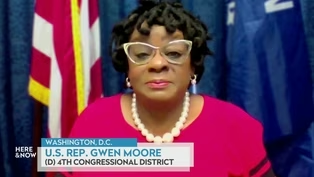
Tonight, we turn to fourth District Democratic Congresswoman Gwen Moore.
And thanks very much for being here.
>> Always great to be with you, Fredricka.
>> So of all the news that is swirling, what stands out for you as you represent your constituents?
>> Well, the thing that is obviously standing out to me is just the unending crush, economic crush that people are facing.
Combination of the tariff tariffs, the war on Iran, the erratic, mercurial functioning of this president, him freezing funds for essential services like daycare and childcare.
These are things that are disrupting everyday Wisconsinites lives.
The crisis with health care and the doubling sometimes of people's health care premiums, or the loss of their health care premiums.
You know, just the aggregation of all these things is placing a huge economic crush on families.
And so that's the thing that sort of stands out to me as the background for all of the very particular things that are happening.
>> As to the ruling related to the Voting Rights Act, that a majority minority district was an unconstitutional racial gerrymander, what does that mean to minority representation?
>> It means an awful lot.
You know, the the 13th, 14th, 15th amendment, the 14th amendment of the Constitution in particular, really guaranteed African Americans equality.
And we we have seen throughout history, this is not new people.
We have seen throughout history sort of lost cause.
You know, Democrats and Republicans grieving over African Americans having access to the ballot, access to power and their willingness to sort of interfere with that power by any means necessary.
You know, the rise of the Ku Klux Klan came as a result of African Americans being enfranchised.
And so this is absolutely no this is a backlash for the power that African Americans have achieved.
And this could have an impact on a minimum of 19 sort of voting, voting rights districts in the country.
>> Turning to the war in Iran, the U.S.
and Iran are reportedly negotiating.
Are members of Congress on both sides tiring of this ongoing war and wanting a say?
>> Well, I'll tell you, we have been putting up war powers resolutions, repeatedly privileged resolutions, which, by the way, the Republicans did not honor.
Yesterday we had yet another war Powers resolution ripen, and they didn't put it before us because they in the House did not have the votes to defeat it.
We've seen more and more and more Republicans join us in putting forth this War Powers Resolution.
To this day, we don't have a concrete reason that we went in there.
>> On another matter in your mind, should Congress have a say over the nearly $1.8 billion fund that resulted out of a settlement President Trump made with the IRS that would pay people the administration believes were unfairly prosecuted.
>> It's all very ludicrous.
I bet Frederica you can't even believe that you're asking this question.
This $1.8 billion slush fund for his cronies and his buddy and, you know, also a part of that other part of that agreement is that Donald Trump and his sons should never, ever, ever be audited again.
That is absolutely the pinnacle of corruption.
But as a member of the Ways and Means Committee, we did we did offer in our markup yesterday, which was on corruption of TANF, for example, corruption.
We did offer amendments to try to get rid of this $1.8 billion fund.
>> Are your voters overwhelmed by the crush of everything that happens out of Washington on a daily basis?
>> You want to know something that I'll say?
The whole political strategy of the Trump administration has been to flood the zone, to just keep us running like a rat on a treadmill so that we won't be able to respond to their chaotic, mercurial governance strategy.
We are hoping to get back into power to really resolve some major threats to our community of interest.
That is the ability for people to vote, the ability of people to be able to go to a doctor, the ability of people to be able to afford, you know, both the bacon and the eggs and, and to be able to live a productive life, to be able to put gas in their cars so they can get to work.
This is this is a this is the American dream just to have normalcy.
And so this is what we're offering voters in the future.
And that is we're keeping our eye on the prize.
>> Congresswoman Gwen Moore, we leave it there.
Thank you so much.
>> Thank you.
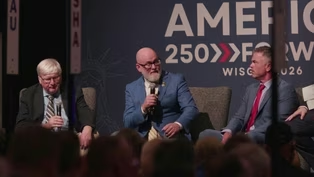
>> Wisconsin Republicans did stake their opinions on some of these issues during the state party convention, where there was high praise for President Trump, mentions of the culture war and an emphasis on kitchen table issues.
When asked what are the most pressing priorities for Wisconsin voters, Congressman Derrick Van Orden responded.
>> It's gas.
Groceries, grandkids.
Gas is going to start coming down E15 right now.
That's up to $0.30 a gallon less.
The the war that Iran declared on us is going to end.
That's going down.
The input costs are already going down for groceries.
So everything is predicated on energy.
Energy production is going up.
That means that the input costs for agriculture going down the farm bill, when signed into law, is going to help tremendously lower the groceries part and then the grandkids.
I think Donald Trump is doing a fantastic job that that implies the security, the security for our nation.
So there hasn't been a single illegal alien released into the United States in a year.
We got the Lake and Riley Act passed.
So if you're a criminal, illegal alien, you know what?
You're getting deported.
>> As the nation honors fallen service members this Memorial Day on Monday, the tourism industry marks the start of the summer season.
A bill in the U.S.
House would re designate the Apostle Islands as Wisconsin's first national park, the 21 islands and 12 miles of mainland off Lake Superior in northern Wisconsin is already a national lakeshore.
Supporters say the designation as a national park would boost tourism and local economies.
Republican Congressman Tom Tiffany introduced the measure and it passed.
Committee this spring.
But local governments in and around Bayfield County and the Red Cliff band of Lake Superior Chippewa oppose the redesignation.
The county and the tribe drafted a formal resolution together opposing it.
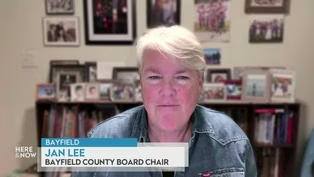
We asked Bayfield County Board Chair Jan Lee why.
And thanks very much for being here.
>> Thank you for having me.
>> So we've done some reporting in Bayfield, kind of during the summer season.
And the crush of tourists can be difficult for small businesses there to manage.
How would a national park designation increase those crowds?
>> Yes.
Thank you.
So I think to to start, like you said, the tourism area here in Bayfield, in particular at the at the gateway to the Apostle Islands has hasn't been a problem in the summertime.
There's never been a problem with not having enough tourists up here in the late spring, summer, early fall, basically through Apple Fest every first weekend of October.
As a matter of fact, we're pretty much bursting at the seams in terms of what we can accommodate in terms of lodging and restaurants.
And that affects workforce, of course.
And we don't have housing for people up here.
It's hard to have to, to to have workforce come in that can accommodate all these tourists for the businesses.
So and I know that Mr.
Tiffany has touted this redesignation as a boon for tourism, but we're we're basically looking for tourism in other directions.
I, you know, I think as a whole, we're, you know, we've done a lot of work over the last 15 to 20 years trying to create tourism as an industry up here, getting people all the way up to northern Wisconsin to enjoy Lake Superior and the inland lakes that we have.
And, and we've done a really good job of that.
But what we've really been trying to do is subsequently also is to try to do that in the shoulder seasons and in the winter, to expand tourism in those areas.
And the big problem with Mr.
Tiffany's bill at this point in time is that we don't know where the infrastructure is going to come to support it.
>> Infrastructure like roads and lodging and parking.
But but wouldn't the Federal Park Service be responsible for that?
>> Well, we are responsible as a county for our roads and I mean the highway department for our county roads and county.
Highway 13 is what gets you up to Bayfield.
It runs through Washburn, which is also a small city about 12 miles south of Bayfield.
And that is also sort of a gateway point to the Apostle Islands, as well as north of Bayfield, where the Red Cliff Lake Superior Band of Ojibwe live.
About two miles north of Bayfield is where the reservation starts.
And they have treaty rights, of course, to the area.
The big.
Another issue that we've we've been sort of trying to address is the treaty rights and the fact that we've.
We've invited Mr.
Tiffany to come.
We want to be a part of the dialog.
We want to share our concerns and our questions, have our questions heard.
But he hasn't come.
And so we received about a year and a half ago or we.
And by that I mean the County Board and the Red Cliff Tribal Council first heard about Mr.
Tiffany's bill resolution H.R.
9111.
And when we heard about it, we found out that the resolution had basically already been written and was already on its way to Washington, D.C.
without consultation with the county board or the City of Bayfield or the Tribal Council.
And so we never got a chance to express our concerns or ask our questions.
And that pretty much left us in an area of the only option that we have left at the federal level is to enact some resolution.
So that's what we did.
We don't normally like to enact negative resolutions.
We like to work in the positive.
And but this is an instance where we felt that since we hadn't been heard or consulted, that we really didn't have another option.
>> What would you be seeking from the federal government or the Federal Park Service to make this thing work?
>> I think, first of all, what we've never heard is an as a as a deeper explanation of why the National Lakeshore designation is already a part of the Park Service.
It's a part of the national parks programing of designation of land matter and bodies of water.
So.
And right now, as the National Lakeshore, it is at one of the highest, if not the highest level of protection, because it is a wild area.
It's a it's a wilderness area.
Even though people live in these small communities on the shoreline, the lake itself and the islands are subject to very dramatic weather shifts and very cold water that as as we know of anybody who knows this area knows, has been responsible for hundreds of deaths, either in ships or boats or people out kayaking or, you know, canoeing, who aren't familiar with how unpredictable this very big lake, which is actually more of an inland sea, how quickly the weather can change, how cold the water is, and how prepared and knowledgeable you have to be in order to embark on it.
So that's one of our concerns, is just the safety of it, of it all as well.
>> Well, we will we will watch this bill as it as it moves through and prepare to visit and do some field reporting up there.
>> We'd love to have you come up, take a look, enjoy.
The area.
>> All right.
Jan Lee from Bayfield County.
Thanks very much.
>> Thank you.
>> Our political reporters covered Tom Tiffany at the state GOP convention, as he was officially endorsed as the Republican candidate for governor.
Tiffany was also in the mix during last week's failed vote at the Capitol over tax relief and public school funding, purportedly calling lawmakers to kill the deal.
A new report out of the Legislative Fiscal Bureau says if it had passed, it could have put the state's budget in a nearly $3 billion deficit in a few years.
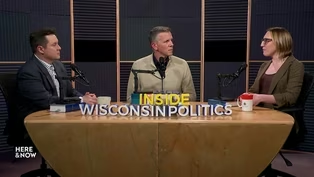
Let's hear what they had to say about it on this week's Inside Wisconsin politics.
>> I think when you're looking at a 2.95 billion projected budget deficit at the end of the next two year budget, not the one we are now, but the one after that feels real to me.
And I mean, just looking through those numbers, right?
>> And, you know, the sort of important caveat is that that number from the Legislative Fiscal Bureau doesn't take into account the fact that we are in a period of sort of remarkable economic so it says that we would have that deficit, that sort of almost $3 billion deficit were this to have passed.
And that's not accounting for potential changes to tax revenue, to the fact that there's like a war going on right now that is affecting oil and gas prices, all these different things.
And so from all of the Democrats who voted against it, and then also from the Republicans who voted concern about the cost of this thing, which was kind of nebulous.
And so even with those kind of firmer numbers, it, you know, justifies, I think, what some of those lawmakers were saying on the floor.
But it also kind of points to this, again, political gamesmanship that we often see when it comes to appropriations, which is what is what is our money for?
What is our state surplus for?
Is it for things like this?
Is it to have kind of in our back pockets?
And so there was that was really the contours of the fight.
>> We had a state GOP convention over this past weekend.
Tom Tiffany is now the endorsed candidate.
He doesn't have to worry about a primary the way that the candidates had to in 2022, so he can focus on the general election now.
And yet, Zac, we're talking about the 2020 election here.
What is Tom Tiffany talking about?
>> He cannot get away from Trump's main grievance, which is the fact that he lost to Joe Biden in 2020.
And because he still has such a powerful grip over the Republican Party nationally, which we just saw in Republican primaries in Kentucky and in Louisiana, Senate races, that his people have to fall in line on his beliefs or his incorrect beliefs that the 2020 election was stolen.
So Tom Tiffany is still answering questions about election fraud investigations and whether Joe Biden won the election with, you know, kind of diffusing or deferring and trying to get away from it because he can't come out and honestly say, no, of course Trump lost.
That's been warranted over and over.
Every Republican group out there, from Vos to the Wisconsin Institute for Law and Liberty has already said so.
And that is something that Democrats love to hear, because they will continue to hang that around his neck all the way to November as much as they possibly can, the closer they tie him to Donald Trump.
And these grievances from four years, six years ago now that the better off it is for them.
>> And Anya, just real quick, I mean, it seems like this is an issue where as much as he wants to go for those handful of voters who are in the middle, this is a line that he can't cross as far as Republicans are concerned.
>> Yeah.
I mean, I think one of the lessons from this week is that in state politics, it's not the time if you are a Republican to be bucking Trump.
And so we are seeing him sort of tie himself again to this issue.
And it'll be interesting to see how much does that motivate his Republican that turn off those moderate voters and >> When it comes to college life?
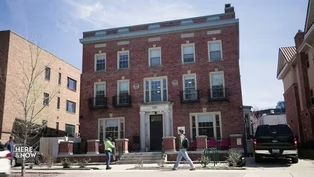
Burlington, Vermont, city of Madison are connected by one house Mansfield Hall tonight, "Here& Now".
Reporter Murv Seymour takes us inside the dorm that provides a one of a kind college experience for students in all three states.
>> I would love a giant MH out front to match the other Greek letters.
>> Nestled on the busy street known as Fraternity Road near UW-Madison.
>> You find a community.
>> Here is a former frat house.
>> We are college housing that is a lot more than just college housing.
>> That is home away from home.
>> You don't just live here.
You thrive here.
>> I'm Ashley.
I'm from Chicago.
The city of Chicago.
And this is Mansfield Hall.
>> Mansfield Hall is a living and learning community that serves college students that are neurodiverse or diverse learners.
It can include someone with ADHD, autism, any kind of learning difference like dysgraphia or dyslexia, processing disorders, anxiety.
>> Oh, here we go.
>> This is brilliant.
Good find.
>> I'm glad I thought of this.
students.
We have students from around the country.
We support students at Madison College, at Edgewood University, and at the University of Wisconsin, Madison.
It can look like course planning.
We do student life support, med management, learning how to cook, learning how to make friends, learning how to communicate, executive functioning.
So setting up systems of support for yourself.
>> Because your Edgewood is probably going to be first week.
>> This floor is all bedrooms.
And of course this one is mine.
So come on in.
>> At this super dorm.
>> It's almost like it was written in the stars.
>> As it's sometimes called.
Sure, you'll find plenty of puzzles and games.
>> Oh, okay.
There.
Because they are weighted differently.
That's what changed.
>> But they do business here too.
There are nearly two dozen students here.
Don't just learn to learn more independently.
>> And I just need to see the numbers and how they.
What happens?
Yeah, yeah.
>> You need the steps.
>> They learn life lessons that help them live more independently.
class either.
So I really don't want to have to take something like that again.
>> UW film student Han Schuberth gets one on one help planning her class schedule.
>> Any props and successes of the day.
>> Gavin Speranza leads the weekly community group.
>> Well, yeah, because that turns into 3/6.
>> Isaac Moore works through complex math equations during what's called Stemtown Katy.
>> How did marketing turn out for you?
>> A weekly tutoring session for those who need help with science.
>> You still got a 92, though.
That's awesome.
>> Technology in math.
>> What worked?
Like what?
What helped overcome the testing anxiety.
Just prepared.
>> The staff here are super helpful.
>> Alissa, Sarah, Naomi.
Eric and Koko.
The canine who casually provides therapy for the house as needed.
Are some of the almost two dozen staff at Mansfield Hall.
Isaac Moore tells me he lives with Attention Deficit disorder.
For him, it's hard to focus and stay organized.
>> It never really impacted my school, so there was never any reason to like, change it.
You know, I would still do well on my tests and stuff.
And so it was like, whatever.
But here, like, I really do have to like, you know, I have a schedule and I have like a meeting with Eric once a week to make sure that I'm like, if I have any questions with math, I'm getting those done.
I have like Google calendar now, so all my classes are in there.
So like I get reminders 30 minutes before class.
I have this class on this day.
I have like due dates in my Google calendar and stuff.
I keep my work more organized.
Like it's not just chicken scratch on eight different papers.
>> Mansfield Hall also provides support that helps students transition from living at their house here on Fraternity Row, before they step out into the community, which helps them to step out in the real world to live on their own once they leave college.
>> I moved into a residence hall at Edgewood.
>> Soon, Bennett Davishoff will graduate and live in his first apartment.
He's in what's called the Connections program at Mansfield Hall, designed for students making the transition away from dorm life to living on their own or with a roommate.
>> I think it's going to be very challenging, very tough.
But I'm willing to.
But I'm excited to give it a try because I because I've always wanted to live independently and I have some symptoms of OCD, ADHD, and autism.
And I can be a perfectionist with the way things look in my room.
I like things to look orderly and clean, which is also a good thing, but it can also be hard.
>> What isn't hard?
>> Give a big round of applause for all of our volunteers today that came in volunteering.
Thank you.
>> We don't have chocolate milk right now, but we do have no fat.
I think.
>> The Senior center in Madison is one of many organizations around town where people from Mansfield Hall lend a helping hand every week.
>> Oh yeah.
Definitely.
Where are the milks?
>> Aiden Mattingly and everyone else say giving back helps them get job ready.
>> Bandana person wants salt and pepper.
>> And it helps them gain something else.
>> I'd say the social skills really it really helps with like talking with people.
And I mean like everyone here is really friendly.
>> And some of those skills can go from volunteering, can go out, can be utilized in when applying for jobs.
>> Can give you the troublemaker ticket.
Oh.
>> One of the senior centers lead volunteers Kat Hemming loves to give.
And she loves the crew at Mansfield Hall.
Without the help of Aiden and the others.
>> All right, let's go to the next table.
>> She says they would probably only have two volunteers.
>> Having the volunteers come in, not only do they talk to the to the seniors and it has more interaction.
It's a lot more exciting.
And they really help.
And they're not just I know it helps them, but it helps us as well.
>> I also don't want to take myself out of this class.
>> Yeah, I wouldn't either.
>> Did I tell you all my second exam scores.
>> For your current classes?
No.
Hall is straightforward.
>> To provide equitable access to higher education and to prepare young adults for the world that can be getting a certificate.
It can be getting an associate's, a bachelor's, a master's.
It can be learning to make a friend group for the first time and just try out college courses.
It can be finding something they're passionate about, feeling seen and heard for the first time.
>> Now.
>> For students to make the most out of being part of the Mansfield Hall family.
Kirstin Bowns hopes every one of them will.
>> Lean into it.
We're not writing the script.
We're just supporting their story.
>> Reporting from Madison.
I'm Murv Seymour for Here and Now.
>> For more on this and other issues facing Wisconsin, visit our website at PBS Wisconsin Education and then click on the news tab.
That's our program for tonight.
I'm Frederica Freyberg.
Have a good weekend.
[MUSIC] >> Funding for "Here& Now" is provided by the Focus Fund for Journalism and friends of PBS Wisconsin.
 New
NewA Better College Life for Neurodivergent Students in Madison
Video has Closed Captions
Clip: S2400 Ep2445 | 7m 5s | Mansfield Hall is a dorm and community that supports neurodiverse college students. (7m 5s)
 New
NewHere & Now opening for May 22, 2026
Video has Closed Captions
Clip: S2400 Ep2445 | 1m 3s | The introduction to the May 22, 2026 episode of Here & Now. (1m 3s)
 New
NewInside Wisconsin Politics: A Projected $3 Billion Deficit
Video has Closed Captions
Clip: S2400 Ep2445 | 3m 33s | Inside Wisconsin Politics on a budget deficit a spending deal was projected to create. (3m 33s)
 New
NewJan Lee on the Apostle Islands National Lakeshore's Status
Video has Closed Captions
Clip: S2400 Ep2445 | 6m 36s | Jan Lee on opposition among local officials to the Apostle Islands as a national park. (6m 36s)
 New
NewUS Rep. Gwen Moore on Redistricting, War in Iran and the IRS
Video has Closed Captions
Clip: S2400 Ep2445 | 6m 39s | Gwen Moore on a deluge of issues facing the nation. (6m 39s)
 New
NewWisconsin Republicans Outline Party Priorities for 2026
Video has Closed Captions
Clip: S2400 Ep2445 | 1m 3s | Republican U.S. Rep. Derrick Van Orden spoke on goals heading into the midterm elections. (1m 3s)
Providing Support for PBS.org
Learn Moreabout PBS online sponsorship
- News and Public Affairs

Top journalists deliver compelling original analysis of the hour's headlines.

- News and Public Affairs

Today's top journalists discuss Washington's current political events and public affairs.










Support for PBS provided by:
Here and Now is a local public television program presented by PBS Wisconsin