
June 29, 2026 - PBS News Hour full episode
6/29/2026 | 57m 46sVideo has Closed Captions
June 29, 2026 - PBS News Hour full episode
June 29, 2026 - PBS News Hour full episode
Problems playing video? | Closed Captioning Feedback
Problems playing video? | Closed Captioning Feedback
Major corporate funding for the PBS News Hour is provided by BDO, BNSF, Consumer Cellular, American Cruise Lines, and Raymond James. Funding for the PBS NewsHour Weekend is provided by...
June 29, 2026 - PBS News Hour full episode
6/29/2026 | 57m 46sVideo has Closed Captions
June 29, 2026 - PBS News Hour full episode
Problems playing video? | Closed Captioning Feedback
Where to Watch PBS News Hour
PBS News Hour is available to stream on pbs.org and the PBS app.
Providing Support for PBS.org
Learn Moreabout PBS online sponsorshipAMNA NAWAZ: Good evening.
I'm Amna Nawaz.
GEOFF BENNETT: And I'm Geoff Bennett.
On the "News Hour" tonight: The U.S.
Supreme Court issues a series of major rulings with far-reaching implications for presidential power and the future of elections.
AMNA NAWAZ: Rescue efforts in Venezuela grow increasingly desperate, as the death toll rises and another aftershock rattles the country.
GEOFF BENNETT: And a new report finds the American dream slipping out of reach for many DACA recipients.
GABY PACHECO, President and CEO, TheDream.US: They have been, in essence, dismantling the program by ensuring that certain DACA recipients from certain countries cannot get status or get their DACA renewed.
(BREAK) GEOFF BENNETT: Welcome to the "News Hour."
The U.S.
Supreme Court today issued two major rulings that significantly expand presidential power and President Donald Trump's attempt to further reshape the federal government.
AMNA NAWAZ: In a 5-4 ruling written by Chief Justice John Roberts, the court's justices said the president does not have the power to fire Lisa Cook, a member of the Federal Reserve Board of Governors.
In the decision, the chief justice wrote -- quote - - "To accept any one of the administration's arguments would in effect transform the Federal Reserve's for-cause protection into at-will employment, an interpretive leap out of step with the statute Congress enacted and our nation's tradition of Central Banking protected from political interference."
But in a separate ruling issue today, Justice Roberts handed the president broader power to fire the heads of independent agencies, overturning a nearly century-old legal president.
In that case, which involved the removal of Federal Trade Commissioner Rebecca Slaughter, the chief justice said -- quote - - "Subordinates who exercise the president's power are subject to removal by him."
The president celebrated the Slaughter decision in a post on his social media platform, saying the justices increased presidential power quote at a time when it's most needed.
For more on today's rulings, I'm joined now by "News Hour" Supreme Court analyst and SCOTUSblog co-founder Amy Howe.
Amy, good to see you.
AMY HOWE: Good to see you too.
AMNA NAWAZ: So two rulings on presidential power, different directions for each one.
And let's start with the ruling for Lisa Cook.
Why did the justices block her firing for now?
AMY HOWE: So, the justices, the majority, by Chief Justice John Roberts, really stressed the importance of the Fed's independence.
They pointed to the First and Second National Banks and said that Congress had really wanted those to be independent, and that the Fed followed in those footsteps.
They talked about the importance of having monetary policy be independent of outside influence and that, if the president could fire a Fed governor for any reason, that it would potentially impede on that independence.
And so they said that Lisa Cook was entitled to notice and an opportunity to be heard before she could be fired, and that she hadn't gotten that when President Trump attempted to fire her in a TRUTH Social post.
AMNA NAWAZ: In a statement, we should note, Lisa Cook hailed the decision as one affirming a key principle that, she put it -- quote -- "that the Federal Reserve must make all its policies and policy decisions guided by evidence and independent judgment and free from political interference."
But, Amy, is this ruling a good sign for the Fed, where the president has tried to exhort more control, or is it just a temporary pause in that fight?
AMY HOWE: I think it's a good sign for the Fed.
We have got five justices who feel very strongly, including Justice Brett Kavanaugh, about the Fed's independence.
And it seems perhaps the president could try to find cause to fire a member of the Fed.
Certainly, this doesn't rule that out.
But the majority's ruling certainly makes it much harder for him to do that.
AMNA NAWAZ: All right, let's turn now to the Slaughter decision that involves the firing of the FTC Commissioner, as we noted.
And Justice Roberts also wrote the majority opinion here, ruling the president can fire members of independent agencies.
How did Roberts justify that presidential power?
AMY HOWE: So it's kind of a corollary to the idea, I think it was Harry S. Truman, the buck stops here.
He talked about the idea that the president is the head of the executive branch and really has to carry out all of the laws.
And he said, to do that, the president needs to make sure that everyone who's working for him is working effectively, and he needs to be able to fire the people who aren't.
And so there was this 1930s decision called Humphrey's Executor, in which the Supreme Court had upheld the very law that Rebecca Slaughter was relying on in this case.
And the Supreme Court basically said that that was a very narrow view of what the FTC was doing then, but certainly now the FTC is exercising what the Supreme Court called executive power.
It enforces laws, it can bring lawsuits, it carries out investigations, it can impose fines, and that's the kind of power that really belongs to the president.
AMNA NAWAZ: Rebecca Slaughter reacted to the ruling today.
Here's part of what she had to say.
REBECCA SLAUGHTER, Former Federal Trade Commissioner: What we have seen is a massive expansion of executive power at the expense of Congress, who designed these agencies to work on behalf of the people and not the powerful.
And it's at the expense of those people, who deserve a government that fights for them without fear or favor and doesn't just reward the president's allies and punish his perceived enemies.
AMNA NAWAZ: Amy, how in your view does this shape or reshape presidential power?
AMY HOWE: It's really an enormous expansion of presidential power.
Justice Sonia Sotomayor in her dissent noted that obviously this doesn't apply just to the FTC, but to, she said, potentially dozens of what had until now been independent agencies, like the Nuclear Regulatory Commission, the Merit Systems Protection Board, and many others that Congress had intended to be independent from the president.
But now the president can control who's part of those agencies.
AMNA NAWAZ: There's another big decision I need to ask you about.
That was the Supreme Court rejecting President Trump's push to review the verdict in the E. Jean Carroll case.
That involved a $5 million civil judgment against him.
That was after a jury found that he had sexually abused and defamed the writer E. Jean Carroll.
the president says that he plans to fight the ruling.
Does he have a path for further appeal here?
AMY HOWE: There's really not much of a path.
Certainly, he could ask the Supreme Court to consider this again.
They almost never do.
This was a really unusual case, in the sense that he'd appealed, asking the Supreme Court to take up this case.
The Supreme Court had put off even considering it over and over again for a couple of months.
And then today, without any comment, they turned it down.
There was no one -- none of the justices, as they sometimes do, wrote any separate writings to say that they would have taken up this case.
There was no sign that any of the justices necessarily were interested in doing anything with it.
AMNA NAWAZ: Another big day at the court.
More to come.
"News Hour" Supreme Court analyst SCOTUSblog co-founder Amy Howe, thank you so much.
AMY HOWE: Thank you.
GEOFF BENNETT: For more on today's ruling that blocked President Trump from firing Federal Reserve Governor Lisa Cook, we are joined now by cook's lead counsel, Abbe Lowell.
Welcome to the "News Hour."
ABBE LOWELL, Attorney for Lisa Cook: It's good to be here.
GEOFF BENNETT: So what was your reaction when you read the Supreme Court's decision today?
What stood out to you most?
ABBE LOWELL: Well, I mean, the first reaction was one of joy and a relief and a little bit of optimism that, in the midst of what is a power grab by this administration and this president, there are some walls left that he cannot get over.
GEOFF BENNETT: The court decided this on narrow procedural grounds, rather than ruling directly on whether a president can never remove a Federal Reserve governor.
So why is that a victory, rather than a deferral of the core question?
ABBE LOWELL: There are two reasons why it is a victory.
To begin with, they just didn't simply say this is a procedural, go back and do it.
It gave some parameters as to what happens.
Remember that this went to the Supreme Court on an emergency docket basis to stop an injunction that we got in the district court.
And because there have been so many of those that the Supreme Court has been willing to overturn, the fact that ours stands strong has to be seen by anybody as a victory.
That's one.
And, as I said, the second reason is it's not just, OK, we saw it, you did it wrong, go do it better.
There are words in the statute that should make it very much more difficult for the president to do what he's trying to do and to infuse politics into the Federal Reserve.
GEOFF BENNETT: Well, it speaks to the constitutional status of the Federal Reserve going forward.
ABBE LOWELL: It does.
So, again, I realize that today was also the decision about other independent agencies, and this is a super-independent agency.
The court made very clear something that we have put forward from the beginning, which is, in American history and in the law, the Federal Reserve Board stands unique.
Having said that, this decision also points out things that others can use.
It does define what due process means about notice and an opportunity to be heard.
And at least in terms of this next chapter, it points out some parameters of what cause can be and what it cannot be.
GEOFF BENNETT: The same court that protected Lisa Cook upheld President Trump's firing of the FTC Commissioner Rebecca Slaughter and expanded his authority over other independent government agencies.
How should we understand that ruling?
ABBE LOWELL: In terms of both, you have to understand them together, I think.
So, look, we now can predict unfortunately many of the votes that take place on this nine-member Supreme Court before a word is uttered or any opinion is written.
And that remained to be the case, unfortunately, in my opinion, in the FTC Slaughter case.
What it means is that this court is not about to be all it can be to put a check and balance on another branch of government, which I and others believe is what the founders wanted.
And, remember, this was not just the court and the president.
It was Congress that created these independent agencies.
And Congress should have a say as well.
So when they established it, we think the precedent -- I think the precedent that applied to the Slaughter case was one that should have been prevailed and not overruled.
That said, remember, again, in the midst of all federal agencies, the Federal Reserve stands alone.
It is an agency, but it also is the U.S.
bank, and it also has a history unlike any other agency, going back to the founding of our country.
And what today was, was the court made very clear to this president and to every president that comes after that this is a unique agency for which, if you're going to try to do something wrong, you're going to be held to a much higher standard.
GEOFF BENNETT: And yet the president says he's pushing forward.
After the ruling, President Trump wrote on TRUTH Social that the case was decided on a strictly procedural basis, and he vowed to take appropriate action immediately to remove Dr.
Cook from the board.
So what's your response to that?
And what options, if any, does the government have left?
ABBE LOWELL: My response is to thank President Trump again, for whenever there could be any doubt that his motives are wrong, that the action he's going to take is improper, or that he is not going to conform to the basis of the Supreme Court's decision, it took him minutes, like a child who's been disappointed by losing a game, to go and say something about, oh, I'm still tougher than the next person.
That said, what he has done in his immediacy is point out that if he thinks that whatever he's going to give now is process, he has undermined that by what he said.
And if he's going to try to come up with some other pretext for what happened to be true cause to remove this governor, he has undermined that as well.
GEOFF BENNETT: So the court, in leaving Dr.
Cook in her position while the underlying litigation continues, what happens next procedurally?
ABBE LOWELL: So what happens next is that the court has made its ruling.
The case still exists in the district court that gave us our injunction.
Remember, the other side of the coin of the emergency docket is, when the Court of Appeals or the Supreme Court doesn't stop something from happening, it continued on.
So, remember, for all those who are paying attention, President Trump purported to fire Dr.
Cook now nine months ago, maybe longer, and she has been a very active and appropriate member of the board ever since.
So what happens now?
We go back to the district court and continue to prove that the president was wrong and the Federal Reserve Board governor was right, and the Federal Reserve Board is a unique agency for which politics should not invade.
GEOFF BENNETT: Abbe Lowell, thanks again for joining us this evening.
We appreciate it.
ABBE LOWELL: It's my pleasure to be here.
AMNA NAWAZ: Venezuelans continued to search for loved ones trapped under debris and rubble, caused by the devastating back-to-back earthquakes five days ago.
And, today, the region experienced a 4.6-magnitude aftershock that rattled rescuers and residents in the disaster zone.
The Venezuelan government estimates up to 1,700 people have died, but that number is expected to climb even higher.
Stephanie Sy has our report.
STEPHANIE SY: The gruff hands of rescuers cradle a newborn, seemingly oblivious to the ruins that surround him.
Baby Juan was trapped beneath concrete for 32 hours.
Mom is pulled out moments later and carried to an ambulance, the baby's robust cries a relief.
Five days after the earthquake struck, the search is on for miracles.
The window for survivability without food or water is closing.
But, today, rescuers pulled this 21-year-old man from the rubble.
Tens of thousands of Venezuelans are still missing.
Ana Rada is searching for her sister.
ANA RADA, Sister of Victim (through translator): Difficult, difficult, but looking forward.
We must have faith, never losing hope.
I'm here.
They said there were signs of life, and I ran up here.
I have faith.
Until I see the body, I have faith.
STEPHANIE SY: Vladimir Moreno (ph) said the family was able to reach his sister, who is believed trapped.
This rescue crew from Turkey is using thermal imaging equipment to detect signs of life.
Another team from the U.K.
brought dogs to La Guaira, the hardest-hit state.
They're specially trained search canines who can sniff out survivors.
Last week's back-to-back earthquakes leveled entire blocks in La Guaira and damaged the country's international airport.
Venezuelans have organized volunteers to help distribute food and other essentials, growing from a few hundred volunteers to now 2,000.
GIL, Volunteer (through translator): Life loses its meaning if we cannot help others.
We should help those in need because no one knows if one day it might be us who need help.
RAFAEL GARCIA, International Rescue Committee: The national hospitals, we have seen numbers of being at over 800 percent capacity.
STEPHANIE SY: Rafael Garcia oversees the IRC's operations in Venezuela and Colombia.
RAFAEL GARCIA: From our side, we're already working with partners on the ground, providing, for example, access to medical support through mobile teams.
They are reporting, and as you would expect in this kind of context, continued mass movement of people throughout the country out of the affected zones.
STEPHANIE SY: Tens of thousands are now homeless, sleeping in shelters.
SUSANA SAAVEDRA, Quake Survivor (through translator): The first thing I hope is they will help me and give me a place to live, because it's very uncomfortable to be like this, sleeping bad, wanting to cook my meals, prepare my things, and have my own room.
That's what I'm hoping for, that they will help us and give us a place to live.
STEPHANIE SY: For now, the focus is still on search-and-rescue.
RAFAEL GARCIA: While the number of missing people is still on those levels of 40,000, 50,000, you just need to keep bringing the resources as much as possible.
Like I mentioned before, we're still in the clock.
They have been called off search-and-rescue operations.
More than two dozen international rescue teams have arrived or are heading to Venezuela.
The U.S.
has pledged $150 million worth of humanitarian assistance overseen by a two-star Marine general.
And American search-and-rescue teams, including this group from Fairfax, Virginia, have been on the ground since last week.
Two days ago, their expertise paid off.
Out of the remains of a building, they pulled this baby out.
And, thankfully, it wouldn't stop crying.
For the "PBS News Hour," I'm Stephanie Sy.
AMNA NAWAZ: Late today, the U.S.
announced it's sending a military unit to Venezuela to assist key airports in facilitating humanitarian assistance.
And we also learned that more than 100 Venezuelans deported from the United States hours before the earthquake are reportedly missing after their hotel collapsed.
According to Human Rights First, which monitors ICE deportation flights, 146 Venezuelans, including 19 women and seven children, were transported to a hotel in La Guaira last Wednesday just before the earthquake struck.
GEOFF BENNETT: We return to the Supreme Court for the day's other headlines.
The justices also ruled today that constitutional privacy protections apply to cell phone location data.
At issue was the police use of what's known as geofence warrants to locate all devices near the scene of a crime back in 2019.
The court ruled that, even when location information is shared with companies like Google and Apple, people don't forfeit their expectations of privacy.
The case was widely viewed as a test for how privacy would be protected in this digital age.
The San Francisco Archdiocese has agreed to pay $395 million to sexual abuse survivors, according to the victim's lawyers.
It settles the claims of more than 500 survivors, the vast majority from decades ago, who said they were sexually abused by members of the clergy.
In a statement, San Francisco's archbishop said - - quote -- "While no financial settlement can erase the painful legacy of past actions, let us pray that God's grace may help to heal all those affected."
The San Francisco Archdiocese and several other dozen other dioceses nationwide have declared bankruptcy as a direct result of child sexual abuse lawsuits.
Global health officials say more than 1,300 deaths have been linked to the record heat wave blanketing Europe.
That toll is likely to rise, as France alone reported at least 1,000 deaths above normal last week during some of the country's hottest ever days for the month of June.
In Berlin over the weekend, police shot water cannons to cool down, sweltering crowds.
And in Budapest, Hungary, temperatures today soared to more than 100 degrees Fahrenheit, far above normal even for summer.
ERIKA, Budapest, Hungary, Resident (through translator): I hardly left home and I'm sweating all over.
This is simply unbearable; 28 degrees Celsius, that used to be summer.
I don't know what this is now.
What is coming to us after this?
GEOFF BENNETT: Meantime, tens of millions of Americans are also under extreme heat warnings this week.
Triple-digit temperatures will bake the Midwest and East Coast as the country prepares for July 4 celebrations.
While dangerous heat settles in over the Eastern U.S.
wildfire conditions remain critical out West.
Fast-moving blazes along the Colorado-Utah border are responsible for the deaths of three firefighters over the weekend.
Seven fires have prompted evacuations, including in Arizona, New Mexico, and Washington state.
Meantime, in Kentucky and Tennessee, at least four people were killed following severe storms this weekend that triggered flash floods.
Kentucky remains under a state of emergency, as cleanup there continues.
In Afghanistan, U.N.
officials there say Pakistani forces conducted overnight strikes that killed at least 28 people, including women and children.
An Afghan official promised that the country would retaliate.
Villagers sifted through buildings that were reduced to rubble.
A top Pakistani official said dozens of militants were targeted and killed in the strikes.
This latest escalation follows months of cross-border fighting that's killed hundreds.
Multiple rounds of talks have so far failed to produce a cease-fire.
In Ukraine, a wave of Russian strikes killed at least 11 people and injured dozens more today.
One of the strikes happened in Dnipro, killing five.
Another hit this minibus in Zaporizhzhia, killing three, including a child.
The attacks follow Ukraine s own heavy drone assault against a major Russian oil refinery this past weekend, the latest in a number of long-range strikes against Russian energy facilities in recent months.
Russia's President Vladimir Putin acknowledged for the first time that his country was facing a fuel shortage as a result.
VLADIMIR PUTIN, Russian President (through translator): The problems persist for both drivers and businesses.
Queues at petrol stations, unfortunately, also remain.
It is not always possible to find the required grade of fuel at present.
And, of course, we understand the difficulties faced by agricultural producers and farming enterprises during this period.
GEOFF BENNETT: Putin later insisted to Russian state TV that the strikes will not bring Moscow back to the negotiating table.
Comcast is planning to split itself into two separate companies again.
The corporate giant announced plans to spin off its remaining media enterprises, NBCUniversal and Sky, into one entity.
The other would focus on its broadband Internet and wireless services.
The planned move comes just months after Comcast separated most of its cable TV networks, such as CNBC and MS NOW.
Comcast shares rose sharply on the news.
Meantime, it was a positive day overall for Wall Street.
The Dow Jones industrial average added more than a half-percent.
The Nasdaq shot up by more than 2 percent and the S&P 500 ended a five-day losing streak.
And some World Cup spoilers ahead.
Five-time tournament champ Brazil beat Japan 2-1 today in a match that was a nail-biter until the very end.
After Japan led at the half, Brazil clawed back and scored the game-winning goal with less than one minute left in stoppage time.
They will advance to the Round of 16, as will Canada after another dramatic late-scoring win against South Africa yesterday.
It's Canada's first ever knock-out round victory in World Cup history.
Still to come on the "News Hour": new education guidelines in Texas challenge the separation of church and state; and Tamara Keith and Amy Walter break down the latest political headlines.
AMNA NAWAZ: Passages from the Bible will now become required reading for the roughly 5.5 million public school students in Texas.
That follows the state Board of Education approving a new mandatory reading list on Friday, the first of its kind in the country.
The Republican-controlled board also approved a controversial overhaul of the state's social studies curriculum for elementary and middle school students.
William Brangham has the details.
WILLIAM BRANGHAM: Starting in the first grade, students will now be assigned at least one mandatory Bible passage per year, along with classics by Shakespeare, Dickens, and Langston Hughes.
The new social studies guidelines emphasize Christian concepts and figures while downplaying the significance of other events tied to race in American history and reducing focus on world events.
The state Board of Education said the updated curriculum would -- quote -- "give students a comprehensive understanding of the arc of history."
But critics say the changes elevate historical disinformation and violate the separation of church and state.
To help us understand these new guidelines and how they came about, we are joined by Jaden Edison.
He's the public education reporter at The Texas Tribune.
Jaden, thank you so much for being here.
Let's start talking about these -- the new requirement, the reading list.
The state Board of Education said that this is a classical correction and that the previous curriculum -- quote -- "resulted in generations of students who do not know the greatness of America or its greatest state, Texas."
Now, opponents, as you have been reporting, argue that this is mostly straight white men, coming at the expense of people of color and women.
And then there are also these Bible passages.
What should we know about this new reading list and specifically what it requires of students with regards to the Bible passages?
JADEN EDISON, Public Education Reporter, The Texas Tribune: Well, this is significant, for a number of reasons, I think the biggest being that, for the first time here in Texas, right, typically, when we have seen the introduction, say, of lesson plans or materials here, as recent as the last couple of years, those have been optional, right?
And districts have had the opportunity to be able to adopt them or not adopt them and to adapt them to children as they see fit.
But the final version that was just authorized effectively, again, is the state saying that children as young as 6 years old, all the way up to preparing to receive your high school diploma, will be required to engage with or read Bible passages.
And again, that's significant.
You look at Texas, right, one of the most diverse states in the nation, not along the lines of just race and ethnicity, but also along the lines of religion, right, you know, Muslims, Buddhists, folks who are not religious at all, right, will be mandated to engage with these materials that have now been required by the state.
And so, certainly, this is this is extremely significant and something that will impact nearly 5.5 million children here in public schools in Texas.
WILLIAM BRANGHAM: We should also remind people that Texas also mandated the displaying of the Ten Commandments in all public schools.
I mean, opponents argue that this kind of biblical education does violate the separation between church and state.
How do supporters justify this?
What do they argue is the reason for mandating this for all those students?
JADEN EDISON: A lot of what you hear is what we have seen really religious scholars and historians dispute, especially in recent years, is this belief that America was founded as a Christian nation, and so, therefore, all of its laws and policies and practices, specifically as we -- you really think about education and the role that plays in developing young citizens, all those institutions should reflect Christian values and beliefs.
And that's what they have said and what they have argued.
And it's also this belief that children cannot learn about, say, for example, Western civilization and European tradition without knowing stories laid out in the Bible.
And so you talk to historians, you talk to educators, you talk to people of various faith traditions, races, ethnicities, certainly, those things are contested, but, obviously, that has been a lot of the rationale for a lot of these policy changes.
You look at the last few years and this feeling that, from conservative advocates and Republican leaders here in the state, that schools are training kids to hate the country because of how they depict America's history of racism and slavery.
WILLIAM BRANGHAM: Let's talk about those changes in social studies.
That was a very contentious process.
Explain those changes and how they will impact students.
JADEN EDISON: I think about these things in tandem, right?
And what we're talking about is a complete rewrite and overhaul of the way Texas has historically taught social studies, right?
And what we're seeing now is a very Texas-centric, American-centric, American exceptionalism-centric lesson approach.
This new approach, right, is in chronological order, but also, currently, students who are in sixth grade, they attend a world cultures class, right, which teaches them about the various governments and traditions of -- again, of different cultures throughout the world.
It's in the name.
Well, that course has been eliminated, certainly, again, a dramatic overhaul of the way things have been taught in Texas and obviously the way things will be taught for years to come.
WILLIAM BRANGHAM: All right, that is Jaden Edison of The Texas Tribune.
Thank you so much for being here.
JADEN EDISON: Thanks for having me.
GEOFF BENNETT: The American dream is slipping further out of reach for young adults who were brought to this country without authorization as children, known as DACA recipients.
That is the conclusion of a new report, which argues the barriers they face are driven not by a lack of ambition or talent, but by policy.
Liz Landers speaks with one of the report's authors.
LIZ LANDERS: This month marks 14 years since the creation of Deferred Action for Childhood Arrivals, or DACA.
For more than 500,000 dreamers, many of them now in their 30s, their future in this country is uncertain.
The policy established under the Obama administration offered undocumented immigrants who entered the U.S.
as minors a renewable two-year period of protection from deportation.
To qualify, recipients must have been living in the U.S.
before June 15, 2007, be in school or have a diploma, and have no criminal record.
The Trump administration is chipping away at the policy, leaving the fate of many of its rules and regulations to ongoing court challenges.
The report, in their own words, examines the postgraduate trajectories of more than 2,500 dreamers with college degrees.
It finds White House policy changes stripping many of some form of legal status or work authorization, leaving one in five of these graduates fully undocumented.
Gaby Pacheco is president and CEO of TheDream.US, the organization that conducted the survey and compiled the report.
Gaby, thank you for joining us.
GABY PACHECO, President and CEO, TheDream.US: Thank you for having me.
LIZ LANDERS: Where does DACA stand now?
There are long wait times for the renewal of DACA recipients.
LIZ LANDERS: Some of these recipients have been deported and detained.
Does DACA still offer the protections that it once did?
GABY PACHECO: I wish I can say yes with certainty.
Unfortunately, right now, where we stand on DACA is, we have the Fifth Circuit that said, yes, we believe that people should have protections.
Unfortunately, that's been over a year, so we don't really know.
And what we have been seeing from the Department of Homeland Security and the Trump administration is that they have been, in essence, dismantling the program little by little by either making the renewals delayed, by ensuring that certain DACA recipients from certain countries cannot get status or get their DACA renewed, and that over 100,000 people that apply for DACA still have their DACA, the initial DACA paused.
LIZ LANDERS: DACA protections include work authorization.
Can you lay out some of the differences career-wise between the alumni in your report who are fully undocumented versus those who do have those work permits?
GABY PACHECO: Yes, what we see is that individuals that have work authorization, six months after they're graduating, they're finding jobs.
And they're finding full-time jobs.
They're finding jobs in their field.
They are fulfilled, and they have been able to actually make more money than their parents combined.
And that, to us, is just exactly what this program is about, creating that generational change and ensuring that young people who are talented and who want to give back can contribute.
On the other hand, the people that do not have work authorization have a lot harder time finding work, and they have lower-paying jobs, they struggle.
LIZ LANDERS: The average age of a DACA recipient now is about 32 years old.
GABY PACHECO: Yes.
LIZ LANDERS: They have dependents, families of their own.
Has the policy kept up with the aging of this demographic?
GABY PACHECO: I don't think so, specifically because the way that we talk about dreamers and DACA recipients tends to be very paternalistic.
We talk about it as if they're young kids.
Realistically, there are some DACA recipients that are into their 40s.
We know that over 300,000 U.S.
citizen children or more have a parent that has DACA.
We know that DACA recipients own homes.
We know that DACA recipients have been, some of them, working in the same job for the last 14 years since they got DACA.
And what we see, right, is that the policy and also our country has not realized and our leaders in our country the potential of integrating this community fully into our country.
What we do not -- what we know is that they're paying billions of dollars in taxes, and, unfortunately, they have to live in two-year increments at a time.
LIZ LANDERS: You were an undocumented student yourself and one of the architects of DACA.
Fourteen years in, is the program still serving the purpose it was designed for?
GABY PACHECO: I would dare to say that the DACA program is likely one of the most successful immigration programs we have had in our 250 years of our country.
I own my own home.
I have been able to fulfill myself, right?
I pay a lot in taxes and contribute.
And this is the story of integration.
I used to hear this a lot.
Why don't you just make the line?
And I'm like, there's no line.
I will make the line if there were.
LIZ LANDERS: The Trump administration has admitted to deporting dreamers and is openly pushing and advocating for dreamers to self-deport.
How do these slow-walking renewals, the stripping of protections from HHS and other agencies, and barring this professional licensure increase the pressure to do that?
Do you see rising pressure on dreamers to self-deport?
GABY PACHECO: I think that is the point of what they're trying to do.
And it's a bit confusing, because what you hear from the mouth of the president about dreamers is very positive.
DONALD TRUMP, President of the United States: Republicans are very open to the dreamers.
KRISTEN WELKER, Moderator, "Meet the Press": You want them to be able to stay?
That's what you're saying.
DONALD TRUMP: I do.
I want to be able to work something out.
GABY PACHECO: He understands the issue.
He says he wants to do something.
Yet the policy and what we're seeing coming out from the administration and the Department of Homeland Security is completely contrary to that.
And the solution is right in the hands of everybody, but yet nobody wants to do something about it.
LIZ LANDERS: You have been advocating for these legislative changes.
Do you think that Congress is going to do anything?
GABY PACHECO: They have to.
And it is up to us to use our voice to push members of Congress to take action and to take action, sooner, rather than later, because, as we see, people are suffering, people are getting deported, people are losing their jobs, and this is not good for our country.
LIZ LANDERS: Gaby Pacheco, thank you so much for coming in.
GABY PACHECO: Thank you for having me.
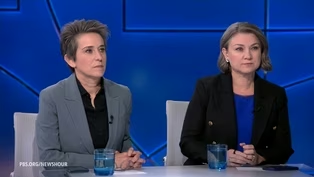
GEOFF BENNETT: The Supreme Court further expands the president's authority, while rejecting President Trump's effort to restrict mail-in voting, leaving that fight to Congress.
For more, we turn now to our Politics Monday duo.
That's Amy Walter of The Cook Political Report With Amy Walter and Tamara Keith of NPR.
It's good to see you both on this very busy Monday.
AMY WALTER, The Cook Political Report: Yes.
GEOFF BENNETT: So, lots of action from the Supreme Court.
Among the flurry of decisions, the court rejected an RNC, Republican National Committee, challenge and ruled that election officials may count mail-in ballots that arrive after Election Day if they're postmarked beforehand.
So, Tam, this leaves existing rules in place for now while basically setting up Congress to legislate on this very issue.
President Trump is talking about his SAVE Act.
Does this ruling from the court give his SAVE Act more momentum, or does it actually lessen the urgency in some ways?
TAMARA KEITH, National Public Radio: I don't know if it lessens the urgency.
The president's urgency is off the charts.
It's just not clear that his Republicans in Congress feel the same level of urgency.
Obviously, some absolutely support his SAVE America Act, but he's running into a wall in the U.S.
Senate, where there are Republican senators who have concerns about some of the provisions in his so-called SAVE America Act which would strictly reduce the availability of mail-in voting for absent -- or not just absentee, but mail-in voting for people in rural areas, for instance, in Alaska, for instance, where Senator Lisa Murkowski opposes the SAVE America Act.
So there are real issues and challenges.
Bigger picture, he is both running into a wall in Congress and also in the courts.
Last week, there were a number of rulings on his various executive orders to try to change the way people vote, and then you get the Supreme Court ruling this week.
So, a pretty significant pushback on the president's effort to impose his ideas on the administration of elections, which the Constitution says is -- should be in the hands of states.
GEOFF BENNETT: And Democrats, meantime, are dead set against this elections bill.
They say it will disenfranchise millions of voters.
The president, to Tam's point, was in the Oval Office today, speaking in support of it.
Here's some of what he said.
DONALD TRUMP, President of the United States: We're the only country in the world that does this type of mail-in ballot.
There's no other country in the world.
You know why?
They tried it and it was totally dishonest.
And it's really dishonest.
So we shouldn't do mail-in ballots.
GEOFF BENNETT: So, the president there again speaking out against mail-in voting.
He says we're the only country in the world that allows this.
That's not true.
What about the his other point that it's dishonest, that it's open to fraud?
AMY WALTER: That's right.
Some states like Oregon, Colorado have been doing -- Washington state -- just vote by mail.
They conduct it entirely through the mail.
There's been no evidence that any of those elections have been tampered with in any way or that the votes are illegitimate.
I think what the president really dislikes about the way that we vote in this country or certain states vote is, because he has been for so long making this claim that is not true that if you vote -- the vote by mail is not safe and it can be tampered with, that Republicans now are going to the polls, rather than sending in ballots.
And Democrats are more likely to be sending in ballots.
So what you see on election night, and this will probably happen when we're together on election night this year, is the early vote, depending on when -- what a state counts first, but if they count the votes that came in that day first, it looks very red.
And then the other votes come in, the mail ballots, which now have become more Democratic.
And so the president goes to bed seeing, oh, 35 percent of the vote is in, the Republican is ahead, we're going to win this seat, wakes up in the morning, and now the Democrat won.
This is not nefarious.
It's just the math.
GEOFF BENNETT: So he seems to have stuck in his head that mail-in voting benefits Democrats, and this is your explanation as to why.
AMY WALTER: Correct, as to why.
And he -- it's sort of a catch-22, because the more that he says you can't trust mail-in voting, the more likely it is that Democrats will do it or more likely that Republicans won't.
And this is what makes Republican strata strategists crazy, because they want to bank as many votes as they can.
And if they can get somebody to put a vote in the mail, they don't need to worry about turning them out to vote on Election Day when maybe it's raining or the dog's sick, and they just forget.
GEOFF BENNETT: And, Tam, this fight over the SAVE America Act has held up this landmark bipartisan housing bill, which the president today he dismissed as a yawn.
Do we have that sound?
I think we do.
We can listen to that as well.
DONALD TRUMP: Here's what I would like to say.
Much more than a bill that -- big deal.
It's a yawn.
Some people say it's wonderful.
To me, compared to the SAVE America Act, just about everything is a big yawn.
GEOFF BENNETT: So in this moment, where every election in this primary leading up to the midterm, the primaries leading up to the midterms, has been about affordability, this would be a layup for the president to say, let's just go ahead and sign this bill.
And yet... TAMARA KEITH: And yet he is stepping on his own feet and stepping on the feet of his members of Congress, the Republicans in the House and the Senate, who worked in a bipartisan fashion to get this through.
President Trump literally called for one of the major provisions of this bill in his State of the Union address, said, Congress, go out and do this.
Congress went out and did it, and he says it's a yawn.
You add this to other things that he has said, where he's not concerned about inflation, or I'm not really focused on affordability or what things cost, there's a larger context to all of those statements.
But, in campaign ads, the larger context will be gone, and he will just be sounding dismissive of the concerns of Americans, who -- like affordability is the top issue, whether it's about housing or the price of gas or the price of groceries or all of these things.
And a lot of Republicans were very and are very eager to be able to run on something like this housing bill.
GEOFF BENNETT: Well, as we talk about the primaries, we have got another one coming up in Colorado.
And we have seen these progressive victories in New York and Washington state.
Tomorrow, tomorrow -- rather, Washington, D.C., not Washington state.
AMY WALTER: D.C., yes.
GEOFF BENNETT: Can't even read my notes here.
But tomorrow's Colorado primary will be a test because you have got Senator Michael Bennet, and you have got the Congresswoman Diana DeGette.
They're facing serious challenges from the left.
What are you watching for?
AMY WALTER: Yes.
So I think there is -- it's very important to put these challenges into different buckets.
I think, in some of the darkest blue state -- darkest blue district -- now, we saw it in New York City, but we have also seen this in Philadelphia, in New Jersey, and now maybe in Denver, where candidates running as a justice Democrat or those basically on the furthest left of the party, many motivated by the issue of Israel, not all, but definitely is a big piece of that, have been successful.
We're going to see tomorrow night in Denver whether that candidate to the left of longtime incumbent Diana DeGette will be successful.
But when we look at the governor's race between Michael Bennet and the state attorney general, the Democrat there, that's really about, who's the better fighter?
And this is really at its core what the Democratic - - if you want to sort of say what are these Democratic primaries really about, what does it mean to be a fighter in this age, and who are you fighting for and what are you fighting against, in the case of, in these dark blue districts, what I'm fighting against, the left, the further left, the Bernie-backed candidates would say is, I'm fighting against corporate oligarchy, the system, the establishment, which can include Democrats.
If you're talking about, in this case, the governor's race, it's, who's fighting Trump the hardest?
The state attorney general, who's filing court cases and winning court cases, or the guy who's been in Washington as one of 100?
And, by the way, Democrats aren't doing anything in Washington.
I'm the one, says the state attorney general, who's really doing the hard work.
And that same debate is going on in a competitive district in Colorado between two Democrats.
So this, to me, is going to be a fascinating question as we get to 2027.
What does it mean to be a fighter, not just with Trump still in office, but looking forward to when Trump isn't in office?
And, Tam, are you following this race out of Alaska, the two Sullivans?
This is my favorite political story.
GEOFF BENNETT: And I will set it up.
I will set it up so folks know what we're talking about.
So this judge in Alaska has ruled that Democrat Dan J. Sullivan can appear on the ballot alongside incumbent Republican Senator Dan S. Sullivan.
So we have seen ballot confusion before.
I would posit, though, that this is probably less of an issue in Alaska, where Murkowski voters had to know not just who she was, they had to know how to spell her name and write it in on a ballot.
GEOFF BENNETT: So I would think that Alaska voters would be able to discern between a Dan S. Sullivan and a Dan J. Sullivan.
How do you see this?
TAMARA KEITH: However, middle names are very different than Murkowski as a full name.
And so it's a top four primary, so it's possible that both Dans Sullivan, I think that might be the plural, make it out of this primary.
Certainly, I think you can get confusion when you're trying to figure out well, what is the middle name of the guy who I voted for before?
Also their logos are oddly similar as well.
So it's not clear exactly what's happening here, but the word shenanigans does come to mind.
AMY WALTER: Well, and the fact that the RNC filed a lawsuit tells you that, yes, they are concerned about voter confusion.
GEOFF BENNETT: More to come on that front, for sure.
AMY WALTER: Indeed.
GEOFF BENNETT: Amy Walter, Tamara Keith, thanks so much.
TAMARA KEITH: You're welcome.
AMY WALTER: You're welcome.
AMNA NAWAZ: Novelist Willy Vlautin has built his career writing about people on the edges of the American dream, working-class families, lonely alcoholics, and those struggling to make ends meet in the fast-changing American West.
While his books have earned comparisons to John Steinbeck, Vlautin is also a musician, telling his stories through song.
Senior arts correspondent Jeffrey Brown traveled to Portland, Oregon, for our arts and culture series, Canvas.
(MUSIC) JEFFREY BROWN: It's not often that a novel comes with its own soundtrack, but author Willy Vlautin is also a songwriter and guitarist with the band The Delines.
And characters like Eddie, a good-hearted, 40-something house painter struggling to get by in Portland, Oregon, appear in songs and at the heart of Vlautin's new novel, "The Left and the Lucky."
WILLY VLAUTIN, Author and Musician: I have always been obsessed with that idea of kind of broken people or people at the fringes, and so there's those who get lucky and stay on the road and there's -- that get left behind.
JEFFREY BROWN: He's written eight novels to date, mostly stories of the dispossessed, the barely making it, the unsung heroes at the margins of contemporary American life.
He works in a small office looking out at Portland St.
Johns neighborhood, surrounded by images, old movie stars, his own heroes, his hometown of Reno, Nevada, a man lying in the street under a sign that reads "Play the Races."
WILLY VLAUTIN: I loved it so much because half the time I feel like that, half the time I'm grateful that I'm not that guy, but I understand that guy.
JEFFREY BROWN: And we spoke recently in the back patio of Marie's, a bar down the street from his office that makes an appearance in "The Left and the Lucky."
Vlautin told me how books and music saved him growing up.
WILLY VLAUTIN: My relationship with books and records started just because I'd find one that made me feel less alone, and I loved them so much.
You're like, you want to hug the book, you want to eat the records, and you realize you can't.
So you have to join up.
JEFFREY BROWN: An early influence was John Steinbeck?
WILLY VLAUTIN: Passionate teachers in Reno, Nevada, taught me Steinbeck, and I bought it hook, line and sinker.
I mean, he wrote about misfits.
He wrote about people that no one else cared about.
He's funny.
When my life was going sideways, I was with Mack and the boys living in the pipes off Cannery Row.
And the other thing was, my mom was a single mom.
She struggled mentally.
She hadn't had a job before, and she had to get a job.
And she got paid less than the men.
She was sexually harassed a lot at work, and she was an oversharer.
JEFFREY BROWN: She told you about all this?
WILLY VLAUTIN: She told me about it all.
So I understood how heroic it can be just to show up for work every day.
(MUSIC) JEFFREY BROWN: Music was his other way forward, including his lead singer and songwriter for the band Richmond Fontaine.
But describing himself as painfully shy growing up, performing brought another problem to overcome.
WILLY VLAUTIN: I forgot that you have to get in front of people.
So I -- from 16 to 33, I just was drunk every time I got in front of people.
JEFFREY BROWN: Drinking was to overcome that?
WILLY VLAUTIN: Oh, yes, that's the only way I could get up there.
And so I was not cut out for it, but it did cure me of being that way.
If it wasn't for being in a band, I probably would be working in a warehouse somewhere, being too shy to barely go to the grocery store.
JEFFREY BROWN: In fact, he did work in warehouses and other odd jobs, including as a house painter in Portland, and got his drinking under control.
WILLY VLAUTIN: I always knew what I wanted to write about, and I always wanted to write about the people around me.
JEFFREY BROWN: And his writing now often features characters here in St.
Johns, one of Portland's historic working-class neighborhoods, who are struggling in a rapidly gentrifying and far more expensive city.
One recent novel, "The Night Always Comes"... ACTRESS: We're in it together.
We're getting into it for the family, OK?
JEFFREY BROWN: ... made into a film last year, comes with a dedication for the Portland that let a hard-living house painter buy his own house.
WILLY VLAUTIN: So many cities in the West, the working-class people of the city get pushed out.
Whole neighborhoods were changing, and housing prices I think went up almost five times.
And so it was shocking to me, the massive growth or influx of money and the way Portland changed.
Yes, I had to write about it.
JEFFREY BROWN: And it became the background for "The Left and the Lucky" and an unlikely friendship between house painter Eddie Wilkens and an 8-year-old named Russell from a broken home, a friendship that just might save them both.
WILLY VLAUTIN: And it was a cool friendship, I think.
JEFFREY BROWN: You enjoyed writing it or finding it?
WILLY VLAUTIN: Oh, yes.
I love -- you can't save people in real life.
Yes, you can barely save yourself.
But, in books, you can take one broken kid and kind of give him a break.
I mean, there's nothing worse than seeing -- like, I can see it.
Just going to grocery store, you see some broken kid or some family.
I can just feel that stuff.
And so writing about it both eases it out of my mind, and then I can change directions.
JEFFREY BROWN: I don't know if I ever heard a writer say this.
So, as a novelist, I mean, you feel like you can save people?
WILLY VLAUTIN: I always felt foolishly that if everything I was scared of, loved was destroyed by, anxiety-ridden by, and put it in a box, I always thought if I took one of those things out and studied it, wrote stories around it from every angle, that it would take the power away of it.
But what I learned is like, you can hold somebody's hand through a hard time, and it just eases my mind.
So you're putting them in a bad situation, yes, sure, but then their friend going through it.
JEFFREY BROWN: At 58, Vlautin says his Delines bandmates, Amy Boone, Cory Gray, Sean Oldham, and Freddy Trujillo, are the musical friends he intends to age and play with.
The long hours of writing are what he's best suited for, he insists, like digging a ditch all day without knowing where you're going.
But being in a band, well, he still loves the music and the people.
WILLY VLAUTIN: The Delines are like the coolest people ever.
So I hope to keep doing that band until I'm really old and playing some lounge somewhere, and writing -- I feel, with books, like I got invited to a party that I wasn't supposed to get invited to.
When they published me, I was like, really?
You're letting me in to this party?
JEFFREY BROWN: You're in.
WILLY VLAUTIN: And then I'm like, OK, then I'm going to work as hard as I can in the corner.
And don't kick me out of the party.
I will be the janitor.
I will be the barback.
It doesn't matter to me.
JEFFREY BROWN: In addition to "The Left and the Lucky" soundtrack, The Delines latest album is titled "The Set Up."
For the "PBS News Hour," I'm Jeffrey Brown in Portland, Oregon.
AMNA NAWAZ: And that is the "News Hour" for tonight.
I'm Amna Nawaz.
GEOFF BENNETT: And I'm Geoff Bennett.
For all of us here at the "PBS News Hour," thanks for spending part of your evening with us.

American dream slipping from DACA recipients, report finds
Video has Closed Captions
American dream slipping out of reach for many DACA recipients, new report finds (6m 46s)
News Wrap: Supreme Court rules location data protected
Video has Closed Captions
News Wrap: Supreme Court rules constitutional protections apply to location data (5m 44s)
Ruling proves Fed is unique agency, Lisa Cook's lawyer says
Video has Closed Captions
Supreme Court ruling proves Federal Reserve is unique agency, Lisa Cook's lawyer says (5m 35s)
Tamara Keith and Amy Walter on Trump's focus on the SAVE Act
Video has Closed Captions
Tamara Keith and Amy Walter on Trump's focus on the SAVE Act (10m 15s)

Texas board mandates students read Bible stories
Video has Closed Captions
Required Bible stories for Texas students challenge separation of church and state (5m 52s)

Venezuela rescue efforts grow desperate as death toll rises
Video has Closed Captions
Venezuela rescue efforts grow desperate as death toll rises and aftershock rattles country (4m 51s)
What the Supreme Court rulings mean for presidential power
Video has Closed Captions
What the Supreme Court rulings mean for presidential power (6m 13s)

Willy Vlautin on spotlighting working-class life
Video has Closed Captions
Willy Vlautin on spotlighting working-class American life in his novels and music (7m 31s)
Providing Support for PBS.org
Learn Moreabout PBS online sponsorship New Episode
- News and Public Affairs

Today's top journalists discuss Washington's current political events and public affairs.

- News and Public Affairs

FRONTLINE is investigative journalism that questions, explains and changes our world.

 New Episode
 New Episode
 New Episode
 New Episode
 New Episode
 New Episode

 New Episode
 New Episode
Support for PBS provided by:
Major corporate funding for the PBS News Hour is provided by BDO, BNSF, Consumer Cellular, American Cruise Lines, and Raymond James. Funding for the PBS NewsHour Weekend is provided by...