
Māhū: A Trans-Pacific Love Letter
9/3/2026 | 26m 5sVideo has Closed Captions
New theater production by Kumu Hula Patrick Makuakāne reclaims and celebrates māhū people.
Kumu Hula Patrick Makuakāne explores the history of the Hawaiian term māhū, or transgender, through the creation of a new theater production for audiences in San Francisco and Honolulu. The film interweaves the multi-media stage performance featuring hula, ‘oli, and moʻolelo with intimate interviews with the artistic collaborators of the show who are all acclaimed Hawaiian transgender artists.
Problems playing video? | Closed Captioning Feedback
Problems playing video? | Closed Captioning Feedback
Funding provided by the Corporation for Public Broadcasting and the National Endowment for the Arts.
Māhū: A Trans-Pacific Love Letter
9/3/2026 | 26m 5sVideo has Closed Captions
Kumu Hula Patrick Makuakāne explores the history of the Hawaiian term māhū, or transgender, through the creation of a new theater production for audiences in San Francisco and Honolulu. The film interweaves the multi-media stage performance featuring hula, ‘oli, and moʻolelo with intimate interviews with the artistic collaborators of the show who are all acclaimed Hawaiian transgender artists.
Problems playing video? | Closed Captioning Feedback
Where to Watch Pacific Heartbeat
Pacific Heartbeat is available to stream on pbs.org and the PBS app.
Providing Support for PBS.org
Learn Moreabout PBS online sponsorshipNATIVE: We are all connected.
NATIVE: When the forests disappeared, we lost our homes.
NATIVE: We lost a lot of our cultural practices after colonization.
NATIVE: But now we're trying to get things back.
IWALANI: Through your art form, people will see your humanity.
NATIVE: We will do whatever it takes for the many generations to come.
♪ ♪ ♪ (relaxing acoustic guitar instrumental) ♪ PERSON: So just today we were in Waipio for halau, right?
PATRICK: Yeah.
PERSON: And I've already... HOOMANAWANUI: First half... (indistinct chattering).
PATRICK: Oh, are, are people in there?
I just wanna say for the record, I don't put on makeup, but I can put mascara on ... My name is Patrick Makuakane and I'm the Kumu Hula for my halau, Na Lei Hulu I Ka Wekiu, and we are in Hawaii for our presentation of "Mahu", which is a celebration of our transgender brothers and sisters.
Well, not only them but everybody along the binary who wants to claim that name.
IWALANI: He says, "I'm going to put on a concert about mahu."
I was like... I'm thinking, "You're going to put on a drag show?"
He goes, "No, no, I want, I want the concept of this show to be about mahu and um, the role that we do in the traditions of hula and Hawaiian music and not like the drag scene and stuff like that."
So I think, "Hey, I'm game, you, let, let me know."
PATRICK: I thought I would just invite my friends, who are amazing transgender, or how we say, mahu, artists, and we would just dance to their work and I would let their artistry speak for themselves.
KAUMAKAIWA: Patrick and I organically found that synergy because of our already avant-gar nature of the content that we put out.
The music, the dance, the choreography and even the perspective.
My name is Hinaleimoana Wong-Kalu and I am privileged and honored to be one of the cast of this production entitled Mahu.
I am going to simply be here to be a part of this production, to give my best, and I hope that people will enjoy.
♪ (gentle synth piano instrumental) ♪ (indistinct background chatter).
♪ ♪ IWALANI: Before our first show, we went to go pray.
And right before we prayed, Patrick told us something that said, "You go out there, you dance your dances, you sing your songs, and through your art form, people will see your humanity."
And I started to bawl in the prayer circle, because I've never thought of it that way.
And so for Friday and Saturday, I am so ready to show them my "humanity" and just scream our songs out and just bang it out.
♪ ♪ HINALEIMOANA: Ladies and gentlemen, and everyone in between... (audience laughing).
HINALEIMOANA: Welcome to Mahu.
(audience applauding).
♪ (atmospheric Hawaiian music) ♪ (singing in Olelo Hawaii).
(singing continues).
(rhythmic drumming).
(chanting in native language).
(singing continues).
(singing fades).
PATRICK: Calling the show 'Mahu', the word itself, probably the most controversial word in all of Olelo Hawaii, if you were to think of one word.
Because everybody who sees that word is going to have a reaction to it, whether, "Wow, this should be fun," and curious, to "Oh my God, I'm not gonna see that show."
Also too, I was curious as to how it was going to play out in San Francisco, where people don't know that word.
And nowhere on the information regarding the concert, on the flyers or advertisements, did I say anything about transgender.
HINALEIMOANA: Mahu speaks to the person, the individual, whom straddles a space between gender binary, male and female.
How each person's duality is either manifest or not.
How their duality might be more one sided than the other.
Everyone is different.
There's no cookie cutter for people who are mahu.
There's a broad and encompassing inclusive spectrum.
KAUMAKAIWA: The term "mahu" in a ritual Hawaiian context, refers to the state of becoming.
What?
Who knows?
PATRICK: And we don't have a lot of information, historical information as to how it was used exactly.
And that's why our show opens with the story of Kapaemahu who were four healers who came from Tahiti to Hawaii, and it says that they were mahu.
And there were, there was a big controversy because there are these huge rock stone monuments in Waikiki, as an expression of gratitude, because these healers healed a lot of people and shared their wisdom with the people of Oahu in this area.
And they put a plaque on it, told the story about them, but left out that they were mahu And that's essential to the story because as healers, to be mahu allows them the capacity to draw in from both the male and female side, especially when you're 'pule', when you're pule or when you pray to your akua, you have male and female akua attending to you.
So that makes you very powerful.
Hina, is, she's awesome.
She's kind of known as this activist in the community for the lahui, for the nation, because she is out there whenever we need a voice.
But I know Hina as an awesome performer, she's a chanter as well as a dancer And the really cool thing is that when she was a boy, she was my hula brother.
HINALEIMOANA: Being in the Royal Dance company and actually trying to deny to everybody in the show... You know, they're all looking at me like, when am I going to like, you know, accept myself.
PATRICK: Right.
HINALEIMOANA: But I'm just denying it vehemently to everybody.
(indistinct chatter).
KAUMAKAIWA: Hinalei was my first introduction to myself, to finding myself and de-shaming the mahu experience for me.
IWALANI: So I have known Hina from seventh grade up until I graduated high school.
And Hina, you could already tell, Hina and Kuaiki, both of them already knew that I was different from the other children, and they treated me like that.
We would never get ready with the boys, they would always hide me on the side and you know, get me, have me get ready by myself.
KAUMAKAIWA: I grew up with steeped in ritual and the ceremony of hula.
And I spent 25 years of my hula life in a loin cloth.
Um, did I enjoy it?
No.
No.
You kind of die a little bit each time.
So after 25 years of putting on a malo I was like, "I can't anymore."
Told my auntie, "I'm sorry, that's not me, And if I keep doing this, I'm gonna lose, I'm not gonna be me anymore."
I was one of the lucky ones that because of my family's contributions the greater, the greater public sort of just embraced without, without question, and allowed me to grow in front of them and, and, and be okay with it.
HINALEIMOANA: Modern day people, especially perhaps within the transgender community, may not take as warmly to it because not everyone wants to embrace their past.
Because it's filled with hurt, it's filled with prejudice and discrimination, and it's filled with negativity.
IWALANI: I grew up in a very staunch Mormon family.
When you grow up in a religion that tells you that being gay or mahu, or anything of that nature, is wrong, and it's pumped into your head from a young child, of course you believe it, you know what I mean?
HINALEIMOANA: It's not something that reconciles too well with Western society, usually American and European types of views.
Because the focus is only on what you can test scientifically and what you can see, what you can behold.
IWALANI: I got teased a lot in school.
Seventh grade, I used to get teased a lot.
Eighth grade, I got teased a lot.
Ninth grade, I got into my first fight.
And what made it hard was is, you cannot go home and tell your parents why you look buss' up.
Most children now, if they get buss' up at school, they go home.
They say, "Oh, you know, they beat me up because I'm mahu," blah, blah, blah.
And for the most part, parents will comfort them and all of this stuff.
In my mind, in the nineties, if I go to school and I get beat up and I come home and my papa and mama ask me why I got beat up, and I tell them because I'm mahu and they didn't like that I'm going to get beat up again for being like this.
It wasn't until 2012 when I sat my grandfather down, and I told him, "I've got something to tell you."
He goes, "What?"
I said, "Um, I'm mahu."
And as soon as, you know, the, the universal parent reaction, "Mm-hmm," you don't even know what comes behind that "Mm-hmm" until they open their mouth again.
And he goes, "Well we all knew, we were just waiting for you to tell us."
And I wanted to bang my head against the door.
I was like, "You mean to tell me for the past 15 years I've been trying to figure out a way to tell you, and I could have told you the entire time because you wouldn't have cared?
And all Papa said was is, "If you think you're a mistake, don't think you're a mistake.
Because if you think that God made a mistake on you, making you like that, then you don't believe in the existence of God, saying that God is perfect and all powerful.
And if he made a mistake, obviously he's not perfect anymore.
♪ (orchestral music playing) ♪ ♪ ♪ ♪ ♪ ♪ ♪ ♪ ♪ HINALEIMOANA: A lot of the times, you don't necessarily want to reveal your past and your history, you don't want to have to relive the footsteps, perhaps because of pain and hurt and trauma.
Once you can accept it... PATRICK: Right.
HINALEIMOANA: It's very empowering.
PATRICK: Right.
IWALANI: For me speaking, it's my cultural identity, that we are the caretakers of tradition, we are the caretakers of song, we are the caretakers of the elderly, the younger ones, the, um, you know, we can, we can go do somebody's hair and then go outside and change the tire to our car after, you know, afterwards.
It's, it's, it's being able to pull from your Hina and your Ku side at any given moment.
KAUMAKAIWA: And for so many years it's been a derogatory term.
Somebody calls you mahu, it's a term, it you want to fight.
Because somehow, that castrate, that socially castrates you.
This is a reclaiming of that term and bringing it out of shame.
PATRICK: How come in hula kahiko, men and women can pretty much dance the same dances, right?
With a few exceptions.
But the dances are non-binary.
(chuckles).
Anybody can dance.
But in auana, there is a huge chasm... a rift.
The guys get the cowboy songs, Mele Aloha Aina, boats, and whatnot, and then the women get all these gorgeous, luscious, lyrical, beautiful songs like, "Pua Ahihi," "Nani Venuse," "Pua Malihini."
And I'm here to tell you, that ends tonight... (audience applause) (Kuini sings in Olelo Hawaii) (singing continues).
(singing continues).
(singing continues).
PATRICK: It is not easy being mahu no matter where you are.
I mean, as a, you talk about bullies now, I mean these were, they were mercilessly bullied as children or even teens, all of them.
But yet they turned out to be such beautiful, loving, kind people.
How did that happen?
And how much of that plays into their artistry?
How much of that hurt was channeled into making the beautiful work?
IWALANI: The Hawaiian music, for me, has been my vessel to show the community, not, not the LGBTQIA+ but like the entire community as a whole that we have other talents than making, decorating you know rooms, than doing hair for proms, than, that we actually do stuff culturally.
And it was because our music transcended our identity.
(Kuini sings in Olelo Hawaii).
(audience applause).
(laughter).
PATRICK: My mahu training began in childhood because my uncle was a bartender for the Glades, which was a well-known female impersonation establishment back in the sixties and seventies So every weekend, like six to twelve of them would come over to our house and they would play Mahjong in the living room, set up the card tables and from like one o'clock in the morning to seven in the morning.
In my limited way, I could understand it as a child that it's tough for them to be that.
But how come?
Because they're so sweet and we all love them.
Why isn't everybody feeling the same way?
And that's another reason why I wanted to do this show.
To just thank those people for those wonderful times and how they took care of me.
And that's, Kuini represents that you know, that sort of buoyancy, that, that really love, love of life exuberance.
(Kuini sings in Olelo Hawaii) (singing continues).
PATRICK: And then there's Kaumakaiwa Kanakaole and she is... From the belly of the volcano, she arises.
(Kaumakaiwa Kanakaole sings in Olelo Hawaii).
(singing continues).
PATRICK: Her music is just like so different from other Hawaiian music.
It's not them, it's not Kuini at all, it's not anything else.
It's unlike anything else.
It's a chanting, guttural, earthly hard, soft, witchy contralto that falls into like sparkling contemporary edges.
It's just really dynamic.
(Kaumakaiwa Kanakaole sings in Olelo Hawaii).
(singing continues).
KAUMAKAIWA: What I hope that a show like this can do is at least peak the conversation within Hawaii.
Because in my mind, this is a love letter to my people.
A gentle and compassionate way in which this conversation seeps into the psyche we're here, we're your brothers, we're your sisters, we're your uncles, we're your aunties.
The hope then is that this love letter to our own people and our own community, is that they remember.
(singing continues).
PATRICK: How can you deny them their humanity and their place at the table?
KAUMAKAIWA: Mahalo a nui for coming to celebrate um, celebrate diversity, celebrate equality, and for celebrating cultural truths.
And those cultural truths are based on aloha and always will be.
And based on inclusivity.
Back to you Paula and Kimo, hit it.
(Kaumakaiwa Kanakaole sings in Olelo Hawaii).
(singing continues).
IWALANI: At this concert, we were able to show like these younger mahu, you are more than just glitter and glamour and eyeshadow and bobby pins and that you actually have a place, culturally, in Hawaii.
KAUMAKAIWA: And so the hope is that Mahu, the production, introduces the aboriginal or indigenous sensibility of queer culture.
IWALANI: So you know, we just keep going and just hopefully that everything just gets better for us.
And we can actually go through a community with people not doing the second glance saying, "I think that's a man.
I think that's a man."
Who cares?
I mean, who cares?
He or she is not bothering you.
You know, who cares what he or she is?
KAUMAKAIWA: Programs like this and performances like this seeps into your spirit and uh, and forces you to remember a time before colonization, a time before western rhetoric, a time before colonial prejudice to indigenous truths of inclusivity.
The hope is that we can... It's blatant.
It's titled Mahu for a reason.
Because we're reclaiming that word, the word that was so, so regularly and so often and so nonchalantly thrown at us to be derogatory.
(speaking in native language).
PATRICK: And I think similar to the word queer how the gay community like took that back and said, "You're not gonna use that as a pejorative anymore.
We're not gonna be humiliated by that, we're just gonna own that word."
That's what Hawaiians are doing today, and they're expanding the definition of mahu.
Where mahu just used to be drag queen or tranny, right?
And it was definitely used to humiliate people.
But now everybody's using it.
I use that term to describe myself and the other artists who are mahu use that term.
Um, so it's an expanding definition of mahu that all of us are claiming, especially for those of us who are a bit older.
And to be able to reclaim it now to say, "I'm gonna use it to give me power rather than to get beat up by it," is, is pretty awesome.
♪ ♪ ♪ ♪ KAUMAKAIWA: Mahalo to Oahu, to all of you for coming to celebrate aloha in its most purest form.
Mahalo to friends and family, to Na Lei Hulu I Ka Wekiu, to the hula lineages that have been supporting me... Ia oukou e ko Hawaii.
We love you, we love you, I love you.
(speaking in native language).
♪ ♪ This is a dance, this is supposed to be fun.
Put your hands together.
(singing in native language).
(singing continues through credits).
(music plays through credits) (waves crashing).
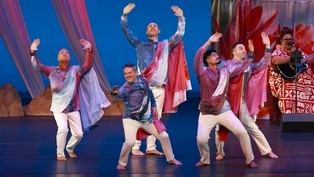
A Beautiful Dance Performance by Kumu Patrick's Men Dancers
Video has Closed Captions
Kumu Patrick Makuakāne designed his show to be inclusive in dance, song, and costume. (2m)
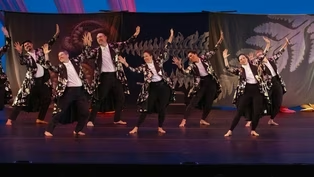
Māhū: A Trans-Pacific Love Letter Preview
Video has Closed Captions
New theater production by Kumu Hula Patrick Makuakāne reclaims and celebrates māhū people. (30s)
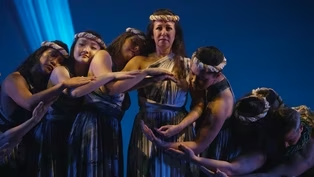
Māhū, The Most Controversial Word In Hawaiian
Video has Closed Captions
What does it mean to be māhū? Kumu Patrick Makuakāne shares why it's the name of his show. (2m 10s)
Providing Support for PBS.org
Learn Moreabout PBS online sponsorship










Support for PBS provided by:
Funding provided by the Corporation for Public Broadcasting and the National Endowment for the Arts.