
Federal board votes to weaken historic site protections
Clip: 7/28/2026 | 6m 15sVideo has Closed Captions
Board packed with Trump allies votes to weaken protections for historic sites
An advisory council packed with Trump allies voted to weaken federal oversight of construction projects affecting historic sites. Critics are concerned that this move will open the floodgates to endangering preservation of historic and cultural places across the country. Jeffrey Brown discussed more with Phillip Kennicott of The Washington Post. It's for our arts and culture series, CANVAS.
Problems playing video? | Closed Captioning Feedback
Problems playing video? | Closed Captioning Feedback
Major corporate funding for the PBS News Hour is provided by BDO, BNSF, Consumer Cellular, American Cruise Lines, and Raymond James. Funding for the PBS NewsHour Weekend is provided by...
Federal board votes to weaken historic site protections
Clip: 7/28/2026 | 6m 15sVideo has Closed Captions
An advisory council packed with Trump allies voted to weaken federal oversight of construction projects affecting historic sites. Critics are concerned that this move will open the floodgates to endangering preservation of historic and cultural places across the country. Jeffrey Brown discussed more with Phillip Kennicott of The Washington Post. It's for our arts and culture series, CANVAS.
Problems playing video? | Closed Captioning Feedback
Where to Watch PBS News Hour
PBS News Hour is available to stream on pbs.org and the PBS app.
Providing Support for PBS.org
Learn Moreabout PBS online sponsorshipAMNA NAWAZ: An advisory council packed with allies of President Trump voted Friday to weaken federal oversight of construction projects affecting historic sites.
GEOFF BENNETT: Critics of the president's controversial projects in Washington are concerned that this move will open the floodgates to endangering preservation of historic and cultural places across the country.
Senior arts correspondent Jeffrey Brown looks at the bigger picture behind this latest move for our arts and culture series, Canvas.
JEFFREY BROWN: President Trump's proposed arch on a traffic circle in Arlington, Virginia, Native American cultural sites in New Mexico's Chaco Canyon, two of the thousands of historic structure sites and more that could be impacted by a proposed change to rules governing construction on federal lands, plus a new executive directive to place signs outside the Smithsonian National Museum of American History calling into question the exhibitions inside.
Joining me to discuss both is Philip Kennicott, culture critic for The Washington Post.
And thanks so much for joining us.
Let's start with this proposed change to what's known as Section 106 of the National Historic Preservation Act of 1966.
Tell us how it works now and what might change.
PHILIP KENNICOTT, The Washington Post: Well, at this point, if the federal government wants to develop a piece of property or make changes that would impact a federally historically protected site, they have to go through a process.
And that process is essentially one of consultation.
They have to talk to the states and potentially to Native American tribes.
And they also have to solicit input from the public.
What's just happened is that the federally appointed body that controls this process has just issued a new set of rules that essentially gut the law.
It would minimize the number of properties that are eligible for review.
It would minimize the kinds of impacts that are considered relevant.
And, most important, it would effectively cut the public entirely out of the process if the government decides they don't want to solicit your opinion and they don't want to hear it.
JEFFREY BROWN: And in terms of potential impact, now, I mentioned two that are well-known, the controversial arch in D.C.
and Chaco Canyon in New Mexico.
What other kind of sites are potentially impacted here?
PHILIP KENNICOTT: This is essentially the big triumphal arch in Washington coming home to a site anywhere near you.
It would impact historic sites all over the country, large and small.
It essentially would allow, theoretically, if a developer wanted to make changes, say, put a golf course next to a historic home or historic landscape,if they got the ear of the president or even the ear of somebody well placed within the relevant federal agency, they could get the public process basically shut down.
They could -- the federal government would decide, no, we don't want to hear from you.
And that will greatly speed the development of that property, no matter the consequences.
JEFFREY BROWN: Now, this change is being led by a little known agency.
It's called the Advisory Council on Historic Preservation, all with appointees by President Trump.
Do you expect legal challenges to come?
PHILIP KENNICOTT: Oh, yes, I think those are already in the works.
And once these laws have gone through the process and been published, you will see a number of avenues that people pursue in legal cases.
I think one of these is that the changes are not consistent with the procedures of the Advisory Council on Historic Preservation.
And they're not consistent with the larger law, the 1960 law on historic preservation.
They also cut a lot of relevant parties, interested parties, like the states and tribes, out of this process.
And so they will have an interest in contesting this as well.
JEFFREY BROWN: All right, so let's turn to this other development that happened recently, President Trump's directive to put warning sides outside the Museum of American History.
We don't know what those signs will say, but this is clearly part of the continuing attack he's made against the Smithsonian at large.
What do you see happening?
PHILIP KENNICOTT: Well, yes, as you're right.
We don't know what the actual particulars of the signs will say.
But they seem to be an effort to basically breach the trust of the public with the Smithsonian.
The president has issued a report that really condemns the Smithsonian for divisiveness, for its focus on wokeness or DEI.
But these reports and these previous efforts to belittle and beleaguer the institution really haven't had much purchase yet.
This seems to be a little bit of theater that's meant to sort of garner attention.
The president has ordered the National Park Service, another greatly beloved part of the federal government that interacts with the people, to put these signs up.
So, effectively, what it's doing is pitting one beloved group against another, the congressionally chartered Smithsonian Institution.
JEFFREY BROWN: So two different developments, two different areas in some ways.
Do you see any connecting tissue here between the two things we have just talked about?
PHILIP KENNICOTT: Well, I think it's about controlling how we tell history, whether that's at the material level of a building or when it comes to the narratives that are intertwined and unfolded in a place like the Smithsonian.
Authoritarian-minded regimes have always understood that there is both an material and an intellectual aspect of history.
And if you can erase history in the material world, in the built world, you assert great power to actually erase narratives in places like the Smithsonian.
And if you have that power, then, of course, you can control the present and the future.
JEFFREY BROWN: There is an argument that these regulations take too long, that projects go on for years and years, so something needs to be changed in the way this is governed.
PHILIP KENNICOTT: Well, they can cite a couple of cases perhaps where they have been burdensome and taken a long time to do, but we could cite, I think, many, many more cases in which a little bit of deliberation, a little bit of time, a little bit of thoughtfulness has preserved important historic and cultural places.
One has only to think about the speed with which the president demolished the East Wing of the White House to get a perspective on what could happen to historic sites all over the country if this supposedly burdensome process is made essentially effortless, so long as you can get the relevant agencies to follow your particular view of the situation.
JEFFREY BROWN: All right, Philip Kennicott is culture critic of The Washington Post.
Thanks so much.
PHILIP KENNICOTT: Thank you for having me.
Emilee Hackney joins Amna Nawaz on 'Settle In'
Video has Closed Captions
On 'Settle In,' Emilee Hackney and Amna Nawaz discuss Appalachian stereotypes (5m 9s)
Graham remembered for impact on South Carolina and the world
Video has Closed Captions
Lindsey Graham remembered for impact on South Carolina and the world (6m 11s)

How state abortion bans are affecting doctors
Video has Closed Captions
How state abortion bans are affecting doctors and how they practice (9m 24s)
Netanyahu and Zelenskyy meet separately with Trump
Video has Closed Captions
What Netanyahu and Zelenskyy are hoping to accomplish after meetings with Trump (4m 21s)
News Wrap: 6.8 magnitude earthquake hits southern Japan
Video has Closed Captions
News Wrap: 6.8 magnitude earthquake hits southern Japan (6m 40s)

Report reveals consequences of Trump's HIV/AIDS funding cuts
Video has Closed Captions
New report reveals consequences of Trump administration's HIV/AIDS funding cuts (7m 30s)
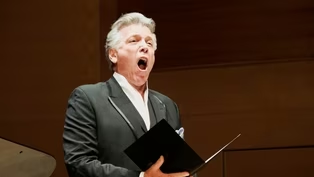
Thomas Hampson celebrates U.S. art with 'Song of America'
Video has Closed Captions
Thomas Hampson celebrates U.S. musical history with 'Song of America' (6m 25s)
Providing Support for PBS.org
Learn Moreabout PBS online sponsorship New Episode
- News and Public Affairs

Today's top journalists discuss Washington's current political events and public affairs.

- News and Public Affairs

FRONTLINE is investigative journalism that questions, explains and changes our world.
 New Episode
 New Episode
 New Episode
 New Episode
 New Episode
 New Episode
 New Episode
 New Episode
 New Episode
Support for PBS provided by:
Major corporate funding for the PBS News Hour is provided by BDO, BNSF, Consumer Cellular, American Cruise Lines, and Raymond James. Funding for the PBS NewsHour Weekend is provided by...